

PEO vs ASO: Which HR Model Fits Your Business?
Choosing between a professional employer organization and an administrative services organization can reshape far more than payroll. A PEO vs ASO decision affects how your company manages HR administration, employee benefits, payroll tax reporting, workers’ compensation, and employer responsibilities. Selecting the wrong structure can create avoidable gaps, costs, and transition work.
Request a PEO consultation to compare support options for your workforce.
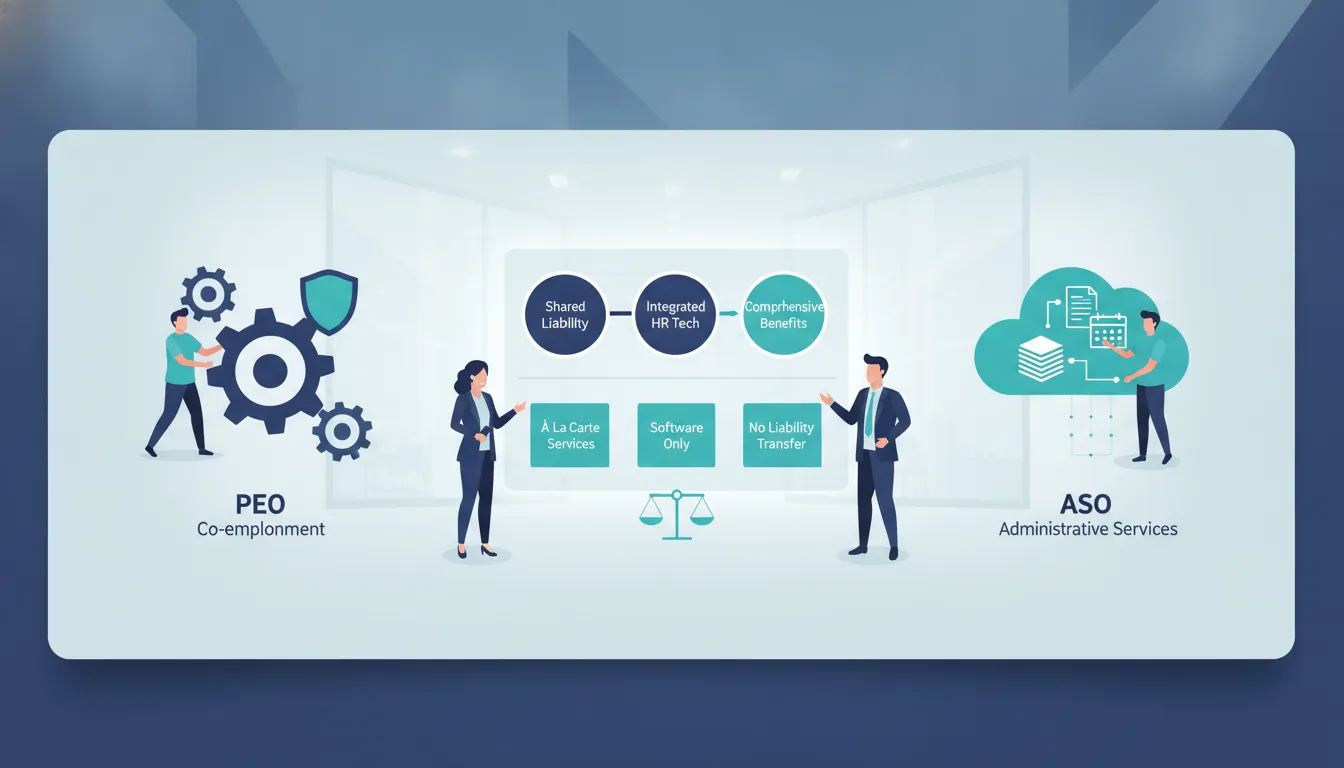
In a PEO vs ASO comparison, the defining difference is the relationship. A PEO generally works through a co-employment arrangement, while an ASO remains a third-party administrative vendor. The right fit depends on how much control your business wants to retain, which responsibilities it wants help managing, and what kind of benefits strategy supports its workforce.
This guide explains the practical differences, offers a side-by-side comparison, and outlines the questions employers should ask before selecting either model.
PEO vs ASO: the core difference
A PEO and an ASO can both provide valuable administrative support, including payroll processing, HR technology, employee onboarding, recordkeeping, and compliance-related workflows. The core difference is structural: a PEO typically uses co-employment for defined responsibilities, while an ASO supports the business as a third-party administrative vendor.
How a PEO relationship works
A professional employer organization typically enters a co-employment relationship with its client. The business remains responsible for its operations, daily management, hiring decisions, workplace supervision, and strategic direction. The PEO becomes an employer of record for certain administrative purposes described in the service agreement.
That arrangement may allow the PEO to handle payroll tax reporting under its tax identification number, sponsor benefit plans, and provide workers’ compensation coverage. Exact responsibilities vary by agreement and applicable law. Employers should review the contract rather than assume every PEO includes the same services.
How an ASO relationship works
An administrative services organization provides outsourced support without becoming a co-employer. The client company remains the sole employer and generally keeps its own tax identification number, insurance policies, benefit plans, and employment-related responsibilities.
The ASO may process payroll, support benefits administration, maintain employee records, or provide HR guidance. It performs the agreed services as a vendor. This structure may appeal to businesses that want administrative help while retaining direct ownership of their plans, policies, and employer relationships.
Why the distinction matters
The difference changes more than paperwork. It can affect who sponsors benefits, how payroll taxes are filed, how workers’ compensation is arranged, and what happens when the relationship ends. Neither structure removes an employer’s obligation to operate responsibly. Each simply allocates administrative functions and certain risks differently.
How do PEO and ASO services compare?
PEO and ASO providers may advertise similar administrative capabilities, but each model allocates plan sponsorship, tax reporting, insurance, and employer duties differently. The table below provides a practical starting point for comparing the models. Actual services depend on the provider, contract, state requirements, and employer needs.
| Evaluation area | PEO | ASO |
|---|---|---|
| Relationship | Usually a co-employment arrangement | Third-party administrative vendor |
| Payroll tax reporting | Often filed under the PEO’s tax identification number | Usually filed under the client’s tax identification number |
| Employee benefits | May provide access to PEO-sponsored plans | Usually administers plans sponsored by the client |
| Workers’ compensation | May be provided through the PEO program | Usually remains the client’s policy |
| HR administration | Shared according to the co-employment agreement | Supported as a contracted vendor service |
| Employer control | Client controls daily operations, with defined responsibilities shared | Client retains sole-employer status and direct control |
| Best-fit signal | Employer wants an integrated model for HR, payroll, benefits, and related support | Employer wants targeted administration while retaining its existing plans and policies |
Similar capabilities do not mean identical outcomes
Marketing materials may list similar features for both models. Two providers might each offer payroll technology, an HR help desk, onboarding tools, and benefits administration. Yet the practical outcome can differ because the PEO may sponsor a plan or assume a defined administrative role, while the ASO administers the employer’s existing arrangement.
Employers should compare responsibilities, not just feature lists. Ask which entity signs forms, files reports, owns employee data, sponsors each plan, and responds when an issue arises.
What changes for HR, payroll, and employer responsibilities?
Both models can reduce repetitive administrative work, but neither turns management into a passive observer. Business leaders still make employment decisions and remain accountable for a safe, lawful, and productive workplace. The agreement determines which administrative tasks the provider handles and which responsibilities stay with the employer.
HR administration and employee relations
A PEO may provide HR resources within a co-employment framework, including policy guidance, handbook support, training resources, and help navigating routine employee matters. An ASO may provide comparable advisory services as a vendor. In both cases, the employer should confirm whether advice is included, limited, or billed separately.
Managers remain responsible for documenting performance, communicating expectations, supervising employees, and applying policies consistently. Before signing, clarify how the provider escalates sensitive matters and whether the employer has access to qualified HR professionals.
Payroll processing and tax reporting
Payroll support can include calculating wages, processing deductions, issuing payments, preparing reports, and helping with tax filings. Under a PEO arrangement, reporting often occurs through the PEO’s tax identification number. With an ASO, filings generally remain under the client’s number.
Ask how the provider handles wage corrections, multistate employees, local taxes, year-end forms, and transitions. A clear implementation plan is especially important because switching payroll arrangements during a tax year can create additional coordination needs.
Compliance support has boundaries
Providers can offer tools, workflows, and guidance, but the employer must understand the limits of that support. A service agreement should identify who monitors deadlines, maintains records, reports incidents, distributes notices, and implements required changes.
A useful rule is simple: if a responsibility matters to your business, it should have a named owner. Do not rely on assumptions or a general promise of compliance support.
How can each model affect employee benefits access?
Employee benefits can influence recruiting, retention, workforce satisfaction, and operating costs. They are also a major factor in the PEO vs ASO decision because the models generally approach plan sponsorship differently. Employers should compare the complete plan structure and employee experience, not only the administrative platform.
Benefits in a PEO arrangement
A PEO may offer access to plans sponsored through its broader program. This can give an employer a different set of plan options and administrative processes than it could arrange alone. Availability, pricing, participation requirements, and plan design vary. Employers should never assume a PEO arrangement will automatically reduce costs or improve coverage.
Benefits in an ASO arrangement
With an ASO, the employer generally continues to sponsor its benefit plans while the ASO handles selected administrative work. That can support continuity and control for a company that is satisfied with its current plans. It also means the employer remains directly responsible for plan decisions and related insurance relationships.
Evaluate benefits around your workforce
Compare networks, deductibles, employer contributions, employee costs, plan choices, enrollment support, and service quality. Consider where employees live, which providers they use, and which benefits matter most to them. Review renewal mechanics and what happens to coverage if the service relationship ends.
InsuranceUnderwriters.com helps businesses examine options across employee benefits, HR, and payroll support. Employers can review how group health insurance supports small businesses and request a group health insurance quote as part of a consultative review that connects plan design and administration choices to workforce needs.
How should employers choose between a PEO and an ASO?
The best choice is not determined by company size alone. Employers should use a disciplined evaluation process that connects the service model to internal capabilities, workforce priorities, budget, and risk profile. A documented comparison also helps decision-makers test provider promises against the actual contract and implementation plan.
- Define the problem you need to solve. Identify whether the main concern is payroll workload, HR capacity, benefits access, workers’ compensation, compliance workflows, technology, or a combination.
- Map current responsibilities. Document who owns each HR and payroll task today. Note gaps, delays, duplicated work, and responsibilities that depend on one person.
- Decide how much control you want to retain. Determine whether your business prefers to keep its own plans and policies or is open to a co-employment structure.
- Compare the complete service scope. Review what is included, optional, or excluded. Compare implementation, ongoing support, technology, reporting, and escalation processes.
- Evaluate benefits and insurance carefully. Compare coverage, networks, plan terms, workers’ compensation arrangements, renewal processes, and transition implications.
- Review responsibilities and contract terms. Understand fees, term length, termination rights, data ownership, liability provisions, and the allocation of duties.
- Plan for implementation and exit. Ask how data will migrate, who will train managers, when employees will receive information, and how records will be returned if the relationship ends.
Signals that a PEO may fit
A PEO may deserve consideration when a business wants a more integrated relationship across payroll, benefits, HR administration, and related services. It may also suit an employer that values access to PEO-sponsored plans and is comfortable with clearly defined co-employment responsibilities. Review these questions about professional employer organization services before comparing proposals.
Signals that an ASO may fit
An ASO may make sense when a company wants to remain the sole employer, keep existing insurance and benefit arrangements, or outsource only selected administrative functions. It can also suit organizations with internal HR leadership that wants additional execution support.
What should you ask before signing an agreement?
A strong proposal should make responsibilities, costs, service boundaries, and transition requirements easy to understand. Ask every prospective provider the same core questions so you can compare answers fairly. Then confirm every important commitment appears in the final contract, service schedule, or another binding document.
Questions about scope and support
- Which HR, payroll, benefits, and risk-management services are included?
- Which services cost extra, and how are those fees calculated?
- Who will be our primary contact, and what are the response standards?
- Which tasks remain entirely our responsibility?
- How are sensitive employee relations issues escalated?
Questions about technology and data
- Which systems are used for payroll, onboarding, benefits, reporting, and employee self-service?
- Can the platform integrate with our accounting, timekeeping, or applicant tracking systems?
- Who owns our employee data, and how can we export it?
- What security controls and business continuity processes are in place?
Questions about transition and contract terms
- What does implementation require from our team?
- How will employees be informed and supported?
- What is the contract term, and what happens if we terminate?
- How are benefits, payroll records, tax filings, and policies transitioned at exit?
Request written answers and compare the final agreement with the proposal. If a commitment matters, make sure it appears in the contract or another binding document.
Get objective guidance on the right HR support model
A PEO vs ASO decision reaches across insurance, benefits, payroll, HR operations, and business risk. An independent, consultative review can help leaders evaluate the complete picture rather than selecting from a feature list alone. It can also surface responsibility gaps and transition questions before they become costly problems.
InsuranceUnderwriters.com provides PEO services, HR management, payroll solutions, and broader commercial insurance guidance for businesses. The advisory process can help clarify your priorities, compare available approaches, and identify the questions that matter before you commit.
Start by reviewing the firm’s employee benefits, HR, and payroll resources and its guide to AI-supported benefits administration, then request a personalized discussion about your goals.
Frequently asked questions about PEO vs ASO
What is the biggest difference between a PEO and an ASO?
The biggest difference is the relationship. A PEO generally works through co-employment and may sponsor benefit plans or report payroll taxes under its identification number. An ASO acts as an administrative vendor while the client remains the sole employer.
Does a PEO control hiring and firing?
The client business generally retains control over daily operations and workforce decisions, including hiring, supervision, and termination. The agreement defines the responsibilities of each party, so employers should review it carefully.
Can an ASO provide HR and payroll support?
Yes. An ASO can provide payroll processing, HR administration, benefits administration, technology, and related services. The client remains the sole employer and typically retains its own plans and policies.
Is a PEO always less expensive than an ASO?
No. Costs depend on service scope, workforce, benefits, insurance arrangements, pricing model, and provider. Compare total costs, responsibilities, and value rather than relying on a single fee.
Can a business switch from a PEO to an ASO?
Yes, but a transition can affect payroll reporting, benefits, workers’ compensation, systems, and employee communications. Review termination terms and build a detailed implementation plan before switching.
Request a PEO consultation
The right support model should match your workforce, internal capabilities, and business priorities. Get a consultative review of your PEO options and the responsibilities that come with them.
Request a professional employer organization insurance quote from InsuranceUnderwriters.com, or review strategic employee benefits considerations for small businesses before your consultation.
Comments
Comments are closed.