
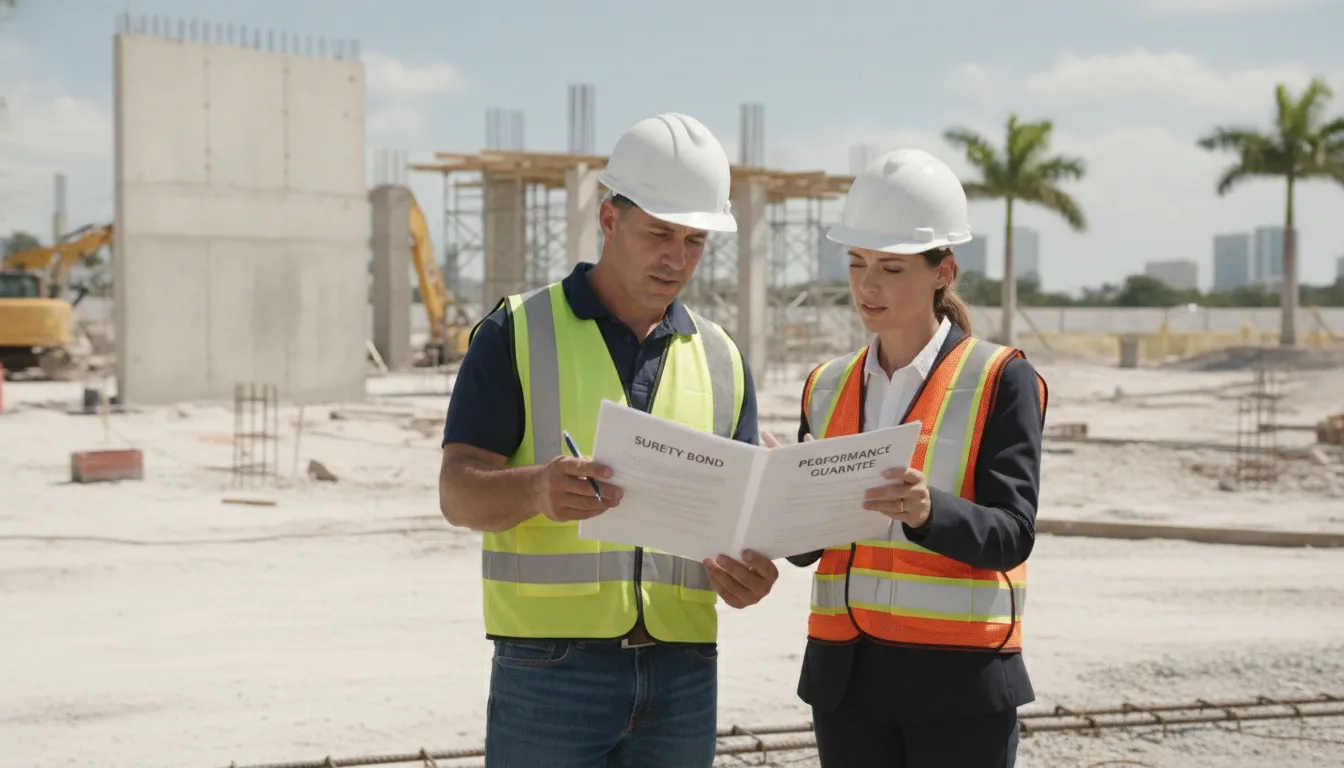
Surety Bonds for Contractors Florida Guide
For Florida contractors, a bond request can arrive with a license application, permit form, bid package, or signed contract. Knowing what the obligee requires before you apply helps prevent delays and keeps your opportunity moving.
Request a Florida contractor bond quote
Surety bonds for contractors Florida are three-party agreements that support a contractor’s promise to follow stated rules or contract terms. The right bond depends on the obligation, the party requiring it, and the exact bond form.
This guide explains the major bond types, pricing mechanics, underwriting factors, and the documents contractors can prepare before requesting a quote.
Surety Bonds For Contractors Florida: How surety bonds for contractors in Florida work
A surety bond is a legal contract that guarantees a contractor will follow state laws and project terms. In Florida, the Construction Industry Licensing Board (CILB) requires these bonds for many professional licenses. While people often call it “bond insurance,” there are clear differences between surety bonds and insurance that every business owner should know.
The three-party bond agreement
A surety bond involves three distinct groups. First is the principal. This is the contractor who needs the bond. Second is the obligee. This is usually a government agency like the Florida Department of Business and Professional Regulation (DBPR). The obligee requires the bond to protect the public. The third group is the surety company. This group provides the financial guarantee.
This structure ensures that if a contractor fails to meet their duties, the surety can pay out a claim. Unlike a standard policy where the carrier pays for your losses, the surety expects you to pay them back for any claims. You can learn more about how to get bonded through our specialized programs.
Licensing and permit requirements in Florida
Florida has strict rules for construction firms. The state divides contractors into groups like Division I for general building and Division II for trades like roofing or plumbing. According to the Florida DBPR, some license types must show proof of financial strength. If a contractor has a lower credit score, the state often needs a bond as a substitute for a higher net worth.
Local cities and counties in Florida may also need their own permit bonds for specific jobs. These bonds make sure you follow local building codes and finish the work as promised. Meeting these Florida construction insurance requirements helps you stay legal and builds trust with your clients.
Qualifying for a contractor bond
To get a bond, you must go through a process called underwriting. Surety firms look at your credit score, business history, and bank statements. They want to see that you have the skills and cash to finish your projects. For large public jobs in Florida, you might need a performance bond to prove you can handle the size of the work.
Since every contractor has a different risk level, we use our network of 200 carriers to find the best fit. We look at your whole business profile to help you get the right coverage at a fair price. This expert help is part of the Commercial Insurance Solutions we provide to help your business grow.
Which contractor surety bond do you need?
Firms in Florida must get bonds to follow laws and help their clients. These bonds act as proof for the public and for job owners that you will do the work well. If you want to start a new firm or bid on a big job, you must know the how to get bonded steps. Each trade and class has its own bond rules you must meet before you work. In Florida, these rules keep the trade safe for all.
State license and permit bonds
Most trades in Florida need a license bond first. This bond shows you will follow the codes and laws of the state. Division I firms, like builders, must often have a $20,000 bond. Division II firms, like HVAC or roof trades, may only need a $10,000 or $5,000 bond. Some firms also need a $100,000 bond for a senior officer. Knowing the differences between surety bonds and insurance is vital when you buy these bonds. These bonds protect the public from bad work or fraud.
You may also need a permit bond for a fixed job in a city. These bonds ensure that you finish the work in that area based on local rules. They are often for small sums. But you still need them to pull a permit for your job. Many local offices in Miami and Tampa have their own bond forms that you must use. You should check your Florida construction insurance requirements to see if you need other coverage too.
Project-based bid and performance bonds
Public jobs often need bid and performance bonds to protect public funds. A bid bond shows that you are a serious bidder for the work. If you win the contract, the performance bond takes its place. It tells the job owner that you will finish the job as agreed. These bonds are very common for state-funded work in Florida. They give peace of mind to the people who pay for new roads and schools.
Bonding for large jobs also depends on your firm’s past and cash flow. Agents look at your past work to see if you can handle a big job. Having the right bonds can help you win more bids and grow your firm. It shows that you are a pro who follows all state and local rules. It is a sign of trust between you and the project owner.
| Bond Type | Main Goal | Who Needs It | Florida Context |
|---|---|---|---|
| License Bond | Follow state laws | New contractors | State-level rule |
| Bid Bond | Back your bid price | Project bidders | Used for public work |
| Performance Bond | Finish the job | Prime contractors | Ensures project end |
| Payment Bond | Pay for labor | Main builders | Ensures sub-pay |
| Permit Bond | Follow local codes | Specialty trades | City or county rule |
Protecting teams with payment bonds
A payment bond ensures that you pay all your workers and tool shops. On large Florida jobs, a main builder often must have this bond. It stops liens from being put on the site if the firm fails to pay for parts or labor. This bond is vital for keeping a good name in the local trade. It also helps small trades feel safe when they work on a big site.
This bond also covers the cost of parts that you use on the job. If a shop does not get paid, they can make a claim on the bond. This keeps the job moving with no slow down or legal stops. In Florida, many public jobs need this bond to protect the subs. It is a key tool for risk on any large building site in the state.
Florida is one of a kind because of its many public jobs and strict rules. The heat and weather can also cause delays that may lead to bond claims. Working with a local agent who knows the state is a smart move. They can help you find the best bonds for your trade and your budget. This helps you focus on building while we focus on your risk.
When does a Florida contractor need a surety bond?
Licensing and financially responsible officers
A state licensing application may require a bond based on the applicant’s license class, financial responsibility, or role in the company. Requirements can change by circumstance, so contractors should confirm the current bond amount and form with the Florida Department of Business and Professional Regulation before applying.
The party requiring the bond is the obligee. Its name, address, bond amount, and required wording must match the issued bond. Even a small mismatch can cause a licensing office to reject a filing.
Local permits and registrations
Florida counties and cities may require a bond before a contractor can register locally or pull certain permits. Local rules and forms vary. Ask the building department for its current bond form rather than relying on a form used for a prior project.
A permit bond supports compliance with local codes and permit terms. It does not replace the contractor’s general liability, workers’ compensation, or other insurance obligations. Review Florida construction insurance requirements separately.
Public and private project contracts
A project owner may require bid, performance, and payment bonds in the solicitation or contract. Contractors should review these terms before pricing the job because bond requirements affect the application timeline, available capacity, and project cost.
Do not assume every project has the same terms. Confirm the bond forms, amounts, delivery deadline, and any special wording with the owner or contracting authority.
How much do Florida contractor surety bonds cost?
The bond amount and the premium are different. The bond amount is the maximum obligation shown on the form. The premium is the amount a contractor pays for the surety to issue the bond.
Factors that shape the premium
Pricing depends on the bond type, required amount, term, and the underwriter’s view of risk. Credit history may be important for license and permit bonds. Contract bonds often require a broader review of company finances, work history, project details, and current backlog.
- Personal and business credit
- Company financial strength and liquidity
- Experience with similar work
- Current work-in-progress and future backlog
- Project size, scope, location, and contract terms
- Prior bond claims or unresolved disputes
A hypothetical pricing example
Assume a contractor needs a bond with a stated amount of $100,000. If an underwriter offers a hypothetical premium equal to 2% of that amount, the premium would be $2,000. This is only an illustration, not a quote or promised rate.
Actual terms can be higher or lower after underwriting. Some small commercial bonds may use a flat premium, while larger contract bonds may use tiered pricing or other methods.
How contractors can manage bond costs
Submit complete and consistent information, address credit issues early, and keep current financial records. A clear explanation of past issues can help an underwriter understand what changed. Contractors can also ask whether a different bond term or project structure affects available options.
What do surety underwriters evaluate?
Surety underwriting asks whether the contractor is likely to meet the bonded obligation and repay the surety if a valid claim is paid. For larger contract bonds, underwriters often organize the review around character, capacity, and capital.
Character and track record
Character includes the contractor’s record of meeting commitments, handling disputes, paying bills, and communicating about problems. Underwriters may review business and personal credit, prior claims, references, and the experience of key owners and managers.
Capacity to perform the work
Capacity means having the people, equipment, systems, and experience to complete the job. An underwriter may compare the proposed project with completed work and evaluate whether the current backlog leaves enough resources for another contract.
A clear work-in-progress schedule helps show active jobs, contract values, costs, billings, and expected completion dates. It also helps the underwriter see how one new job fits the overall workload.
Capital and financial strength
Capital review focuses on liquidity, working capital, net worth, cash flow, and access to credit. Depending on the request, an underwriter may ask for business financial statements, tax returns, bank information, personal financial statements, and an accounts receivable schedule.
Surety bonds may include an indemnity agreement. This generally means the contractor and other indemnitors agree to reimburse the surety for covered losses and expenses. Review the agreement and ask questions before signing.
Insurance Underwriters uses a consultative approach and access to more than 200 carriers to help businesses explore suitable options. Learn more about its commercial insurance solutions.
How to prepare a stronger surety bond application
A well-prepared application gives the underwriter a clear picture of the obligation and the contractor’s ability to perform. Start before the filing or bid deadline, especially when the request involves a large contract bond.
- Identify the exact requirement. Get the current bond form, amount, obligee details, term, and delivery deadline.
- Confirm the business information. Make sure the legal name, entity type, address, ownership, and license details match official records.
- Gather financial records. Prepare the documents requested by the agent or underwriter. These may include financial statements, tax returns, bank information, and a personal financial statement.
- Organize project details. For contract bonds, provide the bid or contract, project scope, schedule, financing details, and a current work-in-progress report.
- Explain unusual items. Give concise context for past credit issues, losses, claims, disputes, or major changes in the business.
- Answer follow-up questions promptly. Clear and consistent responses help the underwriter finish the review.
- Review and deliver the bond. Check names and terms, sign as directed, send it to the obligee, and track any renewal or continuation date.
Build a reusable bond file
Keep core business records current throughout the year. A reusable file can reduce the scramble when a bid or permit deadline appears. Update financials, resumes, project lists, and work-in-progress reports on a regular schedule.
Start before the deadline
Simple requests may need limited review, but complex contract bonds can require several rounds of questions. Early preparation gives the contractor time to correct missing details and discuss alternatives if the first structure is not available.
Common bonding mistakes Florida contractors can avoid
Requesting the wrong bond
Bond names can sound similar, but they support different obligations. A license bond cannot replace a performance bond, and a generic form may not satisfy a local permit office. Get the exact requirement from the obligee before requesting a quote.
Submitting incomplete or inconsistent records
Missing financial pages, outdated company names, and conflicting project totals create questions and slow review. Check every document for consistency before submission. If figures changed, include a short explanation rather than leaving the underwriter to guess.
Contractors should also avoid waiting until bid day to discuss bonding capacity. A large new job can affect cash flow, staffing, and the active backlog. An early conversation helps identify what information the underwriter will need.
Misunderstanding claims and indemnity
A surety bond is not the same as a standard insurance policy. If the surety pays a valid claim, it may seek reimbursement under the indemnity agreement. Read about the differences between surety bonds and insurance before signing.
Finally, track renewal and continuation dates. An expired license or permit bond can disrupt work even when the original application was approved. Keep copies of issued bonds and proof of delivery in a central file.
Get help preparing your Florida contractor bond request
Frequently asked questions
Is a surety bond the same as contractor insurance?
No. Insurance generally transfers covered risk to an insurer. A surety bond supports a contractor’s obligation to an obligee, and the contractor may need to reimburse the surety for a paid claim under an indemnity agreement.
Can a Florida contractor with credit issues get bonded?
Possibly. Approval and terms depend on the bond type, amount, credit history, finances, experience, and other underwriting factors. Contractors should provide complete information and explain the circumstances behind past credit issues.
How long does it take to get a contractor bond?
Timing varies. A small license or permit bond may require a limited review, while a large performance and payment bond request may need detailed financial and project information. Applying early is the safest approach.
Does every Florida contractor need the same bond?
No. Requirements depend on the license, local jurisdiction, permit, project owner, and contract. Ask the obligee for the current bond form and amount before applying.
What documents should a contractor prepare?
The request may call for business details, ownership information, credit authorization, financial statements, tax returns, project documents, resumes, and a work-in-progress schedule. The exact list depends on underwriting.
Request a Florida contractor bond quote
The right bond starts with the exact requirement and a clear application. Insurance Underwriters can help you review the requested form, prepare for underwriting, and explore available bond options without unsupported promises.
Request a bonds insurance quote or call 786-344-9343 to discuss your Florida contractor bond needs.
Comments
Comments are closed.