

Commercial Insurance for Cyber Liability Explained
Cyber Liability Insurance for Business: Why Digital Protection Matters in 2026
Think about your daily operations. You store customer data, accept digital payments, and depend on email. These aren’t just tech company tasks anymore—they’re how modern business gets done. But this also means a single ransomware attack or data breach can stop your revenue cold, damage client trust, and create staggering legal costs. This is precisely why commercial insurance for cyber liability has become essential. It’s not just a safety net; it’s a sign to clients and partners that you take security seriously, allowing you to operate with confidence and compete for bigger projects.
Need protection beyond a standard business policy? Get a commercial insurance quote from InsuranceUnderwriters.com and compare coverage options from top carriers.
The challenge is that many business owners still assume general liability or property insurance will cover a cyber event. In most cases, they will not. Cyber liability coverage is designed for the financial fallout that follows a digital incident, from breach notification and forensic investigation to ransomware response, business interruption, and third-party claims.
What Is Commercial Cyber Liability Insurance?
Cyber liability insurance is a business insurance policy that helps cover the costs of cyber incidents involving data, networks, digital systems, and online operations. It can respond when sensitive information is exposed, software is locked by ransomware, a company network is compromised, or a client alleges that your security failure caused them financial harm.
For many companies, cyber coverage fills a major gap between traditional commercial policies and the realities of modern operations. A fire can damage a building. A slip and fall can create a bodily injury claim. But a phishing email that exposes client records or shuts down invoicing software creates a very different type of loss.
InsuranceUnderwriters.com works with businesses across industries to compare commercial coverage options, including specialty policies that address digital risk. Because the company represents more than 200 carriers and has a team of professional agents, business owners can review options without relying on one-size-fits-all coverage.
Cyber Security vs. Cyber Liability Insurance
It’s helpful to think of cyber security as your proactive defense and cyber liability insurance as your financial recovery plan. Cyber security includes all the tools and practices you use to prevent an incident—firewalls, employee training, and multi-factor authentication are your digital locks and alarms. But even the most secure businesses can be targeted. Cyber liability insurance is designed for what happens when those defenses are breached. It won’t stop an attack, but it provides the capital to manage the aftermath, helping your business cover costs for everything from forensic investigations to legal fees and customer notifications. A strong risk management strategy requires both: robust prevention and a solid plan for financial resilience.
Cyber Insurance vs. Tech Errors & Omissions (E&O)
While they both relate to technology, cyber insurance and Tech Errors & Omissions (E&O) cover fundamentally different risks. Cyber liability insurance responds to security failures, like a data breach or a ransomware attack on your systems. Tech E&O, on the other hand, covers performance failures. It protects you if your technology product or service fails to work as intended and causes a financial loss for your client. For instance, if a hacker steals your customer data, it’s a cyber liability claim. If the software you develop has a bug that corrupts your client’s data, that’s a Tech E&O issue. Distinguishing between the two is vital for building a complete risk profile, especially for tech-enabled businesses that may need both policies to be fully protected.
Why Every Business Faces Cyber Risk
Cyber attacks are not limited to large corporations. Small and midsize companies are often attractive targets because they may hold valuable customer information without the same security budget as enterprise organizations.
The financial impact is also significant. IBM’s 2025 Cost of a Data Breach Report placed the global average cost of a data breach at $4.44 million, with costs varying by industry, geography, incident type, and response speed. The FBI’s Internet Crime Complaint Center reported more than $16 billion in cybercrime losses in 2024, showing how widespread digital fraud, business email compromise, and extortion have become.
Those numbers matter because the real cost of a cyber event is rarely just an IT invoice. A business may need legal counsel, customer notification, credit monitoring, public relations support, forensic specialists, lost income reimbursement, and help restoring operations. Without a dedicated policy, those costs may fall directly on the company.
Cybersecurity Measures vs. Financial Protection
Investing in firewalls, antivirus software, and employee training is an essential first line of defense against digital threats. But even the most robust security can’t offer a 100% guarantee. Cybercriminals are always finding new ways to bypass defenses, and a single sophisticated attack or simple human error can open the door to a breach. This is where the difference between technical prevention and financial protection becomes so important. Think of cyber liability insurance as your financial safety net. It doesn’t replace your security efforts; it works with them, providing the resources to recover from the monetary losses of an attack when your primary defenses are compromised.
For a business leader, the true cost of a cyber incident goes far beyond a simple IT invoice. A breach can trigger a cascade of expenses, including forensic investigations, legal counsel, regulatory fines, and public relations to manage your reputation. The Federal Trade Commission advises that businesses need coverage for these varied and often unexpected costs. A cyber liability policy is built to address this financial fallout, helping to cover lost income from business interruption and the high costs of recovery. At InsuranceUnderwriters.com, we help you integrate this critical protection into your overall risk strategy, turning a potential crisis into a manageable business challenge.
What’s Actually Covered by Cyber Liability Insurance?
Cyber liability insurance can vary by carrier and policy form, but most business policies are built around two major categories: first-party coverage and third-party coverage.
Covering Your Own Losses: First-Party Coverage
First-party coverage helps pay for costs your business incurs directly after a cyber event. Common examples include:
- Data breach response: Costs to investigate what happened, identify affected records, notify impacted individuals, and provide support such as credit monitoring when appropriate.
- Ransomware and cyber extortion: Support for negotiating, responding to, and recovering from extortion demands, subject to policy terms and legal requirements.
- Business interruption: Lost income and extra expenses when a covered cyber event disrupts normal operations.
- Data restoration: Costs to recover or replace damaged data, software, or systems after a covered attack.
- Forensic investigation: Technical experts who determine how the incident happened, what systems were affected, and what must be remediated.
- Crisis management and public relations: Help communicating with customers, vendors, employees, and the public after a serious breach.
Examples of First-Party Costs
So what do these direct costs actually look like after an attack? First, you have the immediate technical crisis. You’ll need to pay forensic specialists to determine how the breach happened and what data was compromised. At the same time, you’ll be spending money to restore or rebuild your essential software and systems. While all this is going on, your business is likely losing income because operations are disrupted. Beyond the tech side, you have a responsibility to your clients. This means covering the costs of notifying affected individuals, offering credit monitoring, and managing your public reputation. These are the direct, tangible expenses that first-party coverage is designed to address, giving you the financial resources to manage the crisis.
Covering Others’ Losses: Third-Party Coverage
Third-party coverage helps respond when another party claims your business caused them financial harm through a cyber incident. This may include:
- Legal defense costs: Attorney fees and related expenses if customers, vendors, or partners bring a claim.
- Settlements or judgments: Covered amounts your business is legally responsible to pay, subject to policy terms.
- Regulatory proceedings: Defense costs or penalties where insurable by law after a privacy or security event.
- Media liability: Claims involving online content, copyright issues, or digital communications, when included.
Cyber policies are not identical, which is why it is important to compare exclusions, sublimits, waiting periods, ransomware conditions, and breach response resources before choosing a carrier.
A Note on Ransom Payments
Ransomware is one of the most disruptive threats a business can face, and a common question is whether insurance will cover the ransom demand itself. While many cyber liability policies offer coverage for cyber extortion, it’s not as simple as paying the hackers and submitting a claim. A critical detail is that the insurance carrier must typically approve the payment before it is made. Beyond covering the ransom, a strong policy provides access to a team of crisis responders, including expert negotiators and forensic specialists who can manage the incident. The decision to pay involves complex legal and operational factors, so having your insurer as a strategic partner in that process is one of the most important benefits of a well-structured cyber policy.
First-Party vs. Third-Party: Which Cyber Coverage Do You Need?
| Coverage Type | What It Protects | Common Examples |
|---|---|---|
| First-party cyber coverage | Your own business losses after a covered cyber event | Ransomware response, data recovery, breach notification, lost income, forensic investigation |
| Third-party cyber liability coverage | Claims made against your business by clients, vendors, regulators, or other outside parties | Legal defense, settlements, privacy claims, regulatory response, client damage allegations |
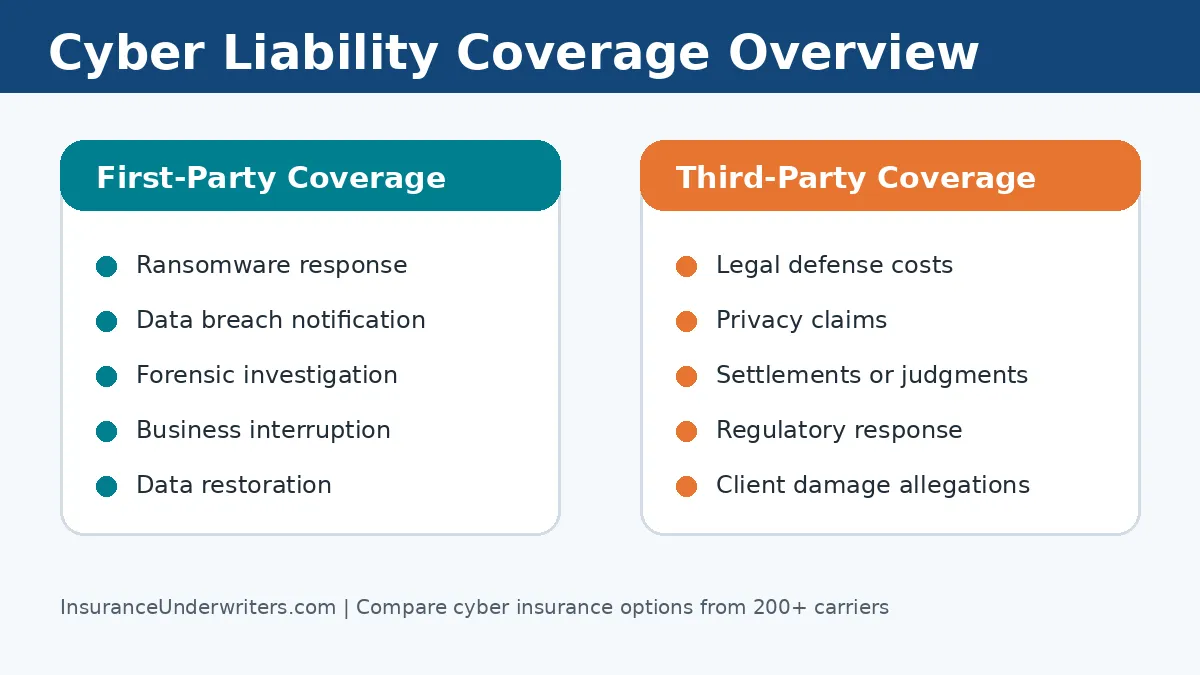
Bottom line: First-party coverage helps your company recover. Third-party coverage helps protect your company when others say your cyber failure harmed them. Many businesses need both.
Does Your Industry Need Cyber Liability Insurance?
Any company that uses digital systems should consider cyber insurance, but some industries face higher exposure because they handle sensitive information, process payments, or depend heavily on uptime.
- Healthcare and wellness practices: Patient records, billing information, appointment systems, and privacy requirements create serious cyber exposure.
- Professional services: Accountants, consultants, attorneys, agencies, and other advisors often store confidential client information.
- Retail and ecommerce: Payment processing, customer accounts, inventory systems, and online ordering can all be targeted.
- Real estate and property management: Wire transfers, tenant information, owner records, and vendor payments create fraud risk.
- Construction and trade businesses: Bid documents, payroll systems, supplier portals, and project management software are increasingly digital.
- Technology companies: Software providers, IT consultants, and managed service providers may face both first-party losses and client claims. See our technology insurance guide for related coverage considerations.
- Startups and LLCs: Newer businesses may be especially vulnerable because they are building systems quickly. If you operate through an LLC, our LLC insurance guide explains why the entity alone does not replace proper coverage.
Cyber insurance should also be considered when contracts require proof of coverage. Vendors, landlords, enterprise clients, and government buyers may ask for cyber liability limits before work begins.
Contractual, Legal, and Association Requirements
Beyond protecting your own assets, the need for cyber insurance is often driven by outside parties. It’s becoming increasingly common for contracts to require proof of coverage before work can begin. Enterprise clients, government buyers, and even commercial landlords may mandate specific cyber liability limits to ensure their own data and operations are protected when working with you. This is especially true for businesses in professional services, technology, and healthcare, where you might handle sensitive customer details or employee records. Without the right policy, you could be disqualified from major projects or partnerships, putting a hard stop on growth before it even starts. This makes cyber insurance a key tool for not just risk management, but for business development as well.
How Much Cyber Coverage Is Enough for Your Business?
The right limit depends on the size of the business, the type of information handled, contractual requirements, annual revenue, and how much the company depends on digital systems. A small professional services firm may need a different limit than an ecommerce company processing thousands of transactions per month.
When reviewing coverage, consider these questions:
- How many customer, employee, or patient records do you store?
- Do you accept credit card payments or ACH transfers?
- Could your business operate if email, accounting software, or your website went down?
- Do client contracts require specific cyber liability limits?
- Do you use third-party vendors that connect to your systems?
- What would one week of downtime cost in lost revenue, payroll, and customer impact?
Cyber coverage should be reviewed alongside other commercial policies. If you are comparing broader protection, our guide to business insurance costs explains factors that affect pricing across multiple policy types.
Want help comparing limits and policy terms? Request a business liability insurance quote and ask about cyber liability options for your company.
Understanding the Cost of Cyber Insurance
So, what’s the price tag on this kind of protection? The cost of cyber liability insurance isn’t a simple, flat fee. Instead, it’s calculated based on your company’s unique risk profile. Insurers look at a variety of factors to determine your premium, including your industry, annual revenue, the types of data you manage, and the strength of your current cybersecurity practices. The amount of coverage you choose also plays a big role; a $500,000 policy will naturally cost less than a $2 million policy. Think of it as an insurer trying to understand the likelihood that your business will file a claim and how much that claim might cost. A company with a solid security framework and non-sensitive data will likely pay less than a company with weaker controls that stores thousands of financial records.
Factors That Influence Your Premium
When you apply for cyber insurance, the carrier performs a detailed underwriting process to assess your risk, and the price you pay is a direct reflection of that assessment. Key factors include your industry, annual revenue, and the number of sensitive records you store. For example, a healthcare provider will almost always face higher premiums than a small construction firm because of the high value of patient data and strict regulatory requirements. Your claims history and existing security measures are also critical. Demonstrating that you use multi-factor authentication, conduct regular employee security training, and have a formal incident response plan can often lead to more favorable pricing, as it shows you are a proactive partner in managing risk.
The Type of Data You Handle
Not all data is created equal in the eyes of an insurer. The type of information your business collects, stores, and transmits is one of the most significant factors in determining your premium. Protecting highly sensitive data, such as Social Security numbers, credit card details, or medical records, costs more because the financial and reputational damage from a breach is much greater. In contrast, a company that only handles less sensitive information, like customer purchase histories or email addresses for a newsletter, may see a lower premium. Essentially, the more valuable your data is to a potential attacker, the higher the risk, and the more you can expect to pay for coverage.
Are Cyber Insurance Premiums Tax-Deductible?
Yes, in most cases, cyber liability insurance premiums are tax-deductible for businesses. The IRS generally allows companies to deduct expenses that are considered both “ordinary and necessary” for their operations. As cyber attacks have become a common threat to modern companies, insurance that protects against these digital risks typically falls into this category. This means you can usually write off the cost of your premium, which helps offset the overall expense of the policy. Of course, tax laws can be complex, so it’s always a good idea to consult with a qualified tax professional to understand the specifics of deducting business expenses for your company.
How to Choose the Right Cyber Liability Policy
Choosing cyber insurance is not just about finding the lowest premium. The details determine whether the policy works when a real incident occurs.
- Review first-party and third-party coverage: Make sure the policy addresses both your direct recovery costs and claims from outside parties.
- Check ransomware and extortion terms: Look for sublimits, coinsurance, required security controls, and response procedures.
- Understand the business interruption waiting period: Some policies require a set number of hours before lost income coverage applies.
- Compare breach response resources: Strong policies may include access to forensic firms, legal teams, notification vendors, and crisis support.
- Look at exclusions: Common issues include prior known events, failure to maintain required controls, acts of war, or unsupported systems.
- Match coverage to contracts: If a client requires cyber liability, verify the limit, additional insured wording, and certificate requirements.
- Coordinate with other policies: Cyber insurance should work with your general liability, professional liability, crime, and property coverage instead of leaving gaps.
A licensed insurance agent can help interpret policy language and compare carrier options based on your actual risk profile. InsuranceUnderwriters.com offers access to more than 200 carriers, giving business owners a broader view of available solutions than a single-carrier quote.
Standalone Policy vs. Endorsement
When you’re looking to add cyber protection, you’ll generally find two options: a standalone policy or an endorsement. An endorsement is a small add-on to an existing policy, like your Business Owner’s Policy (BOP). It might seem like a simple, low-cost solution, but it often provides very limited coverage with low limits and significant exclusions. A standalone policy, on the other hand, is a dedicated contract designed specifically for cyber risks. As a business insurance policy, it offers much broader protection, higher limits, and access to specialized breach response services. For any business that takes its digital operations seriously, a standalone policy is almost always the right strategic choice. It’s built to handle the complex financial fallout of a real-world cyber incident, not just check a box.
Key Policy Features to Look For
Once you’ve decided on a standalone policy, the next step is to look at the details. Cyber insurance is not a commodity, and the fine print can make a huge difference in whether your claim gets paid. A lower premium might be tempting, but it could come at the cost of critical coverage features. When you compare policies, you’re not just looking at the price and the overall limit; you’re evaluating the carrier’s commitment to helping you recover. Key features like the insurer’s duty to defend, coverage for third-party vendor failures, worldwide protection, and access to a 24/7 breach hotline can determine the outcome of an incident. Let’s look at why each of these is so important.
Duty to Defend
If a client sues you after a data breach, who pays for the lawyer? The answer depends on your policy wording. Look for the phrase “duty to defend.” This means your insurance carrier must step in and manage your legal defense from the start, paying for the attorneys and related costs directly. The alternative is a “duty to indemnify” or reimbursement policy, where you hire your own lawyers, pay the bills, and then ask the insurer to pay you back. A duty to defend provision is far better for your cash flow and peace of mind. The insurer handles the logistics, giving you access to experienced legal counsel without the upfront financial burden, even if the claim against you is ultimately found to be without merit.
Third-Party Vendor Coverage
Your business doesn’t operate in a vacuum. You rely on cloud providers, payment processors, scheduling software, and other third-party vendors to run your company. But what happens if one of them has a security failure that causes your business to lose money or exposes your client data? Your cyber policy should help. Strong policies include coverage for incidents originating with your vendors. This is a critical feature because your company’s digital supply chain is a common source of risk. Third-party coverage ensures your policy can respond when another party’s mistake creates a claim against you or a direct loss for your business, protecting you from risks that are technically outside your direct control.
Worldwide Coverage and Cyber Terrorism
Cyberattacks are borderless. An attacker in another country can target your systems, and your data may be stored on servers located anywhere in the world. Your policy needs to reflect this reality. Make sure your coverage applies no matter where an attack originates or where data is held. Another complex issue is cyber terrorism. Many insurance policies contain an “act of war” exclusion, which can be interpreted broadly in the case of a state-sponsored cyberattack. It’s important to see how a policy defines this. Some policies offer specific “write-backs” that provide some coverage for terrorism, ensuring you aren’t left unprotected after a major, widespread event. Your coverage should apply globally to be effective.
Access to a 24/7 Breach Hotline
When you suspect a cyber incident, the first few hours are critical. The decisions you make can have huge legal and financial consequences. This is why one of the most valuable features of a good cyber policy is access to a 24/7 breach hotline. This isn’t just a customer service number; it’s your direct line to a team of experts, often starting with a “breach coach” who is an attorney specializing in cyber law. They can immediately help you understand your obligations, preserve evidence, and deploy the right resources, such as forensic investigators and public relations firms. Having this expert guidance on call, any time of day or night, helps you avoid costly mistakes and begin the recovery process correctly from the very first moment.
What Isn’t Covered by Cyber Insurance?
Cyber liability coverage is important, but it is not a substitute for good security practices. Carriers may ask about controls such as multi-factor authentication, endpoint protection, employee training, backups, encryption, patch management, and vendor access.
Better security can also support better insurance outcomes. Businesses that document controls, train employees, and maintain recovery plans may have more options when applying for coverage. Cyber insurance and cybersecurity should work together: one reduces the chance and severity of an event, while the other helps fund recovery if an event still happens.
General Liability Exclusions
It’s a common misconception that a general liability policy will cover a digital disaster. In reality, most general liability insurance is designed to cover tangible losses like bodily injury or physical property damage. It was not built for the world of data breaches and ransomware. As cyber incidents became more common, insurance carriers started adding specific exclusions to their general liability policies to make it clear that data-related events are not covered. This means you can’t rely on your standard business policy to respond after a phishing attack; you need a dedicated cyber liability policy to fill that critical gap.
Loss of Intellectual Property
While a cyber policy is great for covering the direct costs of a breach, like forensic analysis and customer notifications, it has its limits. A key exclusion is the value of your intellectual property (IP). If a hacker steals your proprietary software code, secret formulas, or a client list you’ve spent years building, the policy won’t pay you for the commercial value of that lost information. It also doesn’t cover indirect losses that are harder to quantify, such as damage to your brand’s reputation. The policy is there to help you recover operationally, not to replace the inherent value of your company’s unique ideas.
Pre-Existing Incidents or Flaws
Cyber insurance is designed to protect against future, unknown events, not problems you already have. Policies do not cover incidents that were in progress before your coverage began or security flaws you were aware of but didn’t disclose. This is often called a “prior acts” exclusion. Think of it this way: you can’t buy homeowners insurance for a house that is already on fire. This is why it’s so important to get coverage in place before you have a problem and to be transparent on your application. The goal is to transfer future risk, not to get a payout for a past mistake.
Intentional Acts and Internal Crime
Cyber liability insurance is there for accidents and external attacks, not for deliberate wrongdoing from within your own company. If a business owner or executive intentionally causes a data breach, the policy will not respond. Likewise, it does not cover intentional crimes by your employees, such as an IT manager who steals data to sell on the dark web. For those situations, you would need a different type of policy. A commercial crime insurance policy, for example, is specifically designed to address losses from employee dishonesty, theft, and fraud.
Acts of War or Government Action
Nearly all insurance policies, including cyber liability, contain an “act of war” exclusion. This means the policy will not cover losses resulting from military action, war, or government-sponsored cyber warfare. While this might seem like a rare event, it can become a gray area in the digital world. It can be difficult to definitively attribute a large-scale cyber attack to a specific nation-state, which can lead to complex coverage questions. As a business owner, it’s important to understand that if a major cyber event is officially declared an act of war, your policy may not apply.
Failure to Maintain Security Standards
When you apply for cyber insurance, you are making a promise to the carrier that you have certain security controls in place. Your application is a warranty. If you state that you use multi-factor authentication (MFA) on all accounts but fail to do so, and that failure leads to a breach, your claim could be denied. Carriers expect you to maintain the security posture you described. As we note on our commercial insurance page, better security supports better insurance outcomes. This makes it essential to not only implement strong controls but also to document them and ensure they are consistently maintained across your organization.
The Growing Threat: How AI Impacts Cyber Risk
AI is rapidly changing how businesses operate, but it’s also handing cybercriminals powerful new tools. Attackers are using artificial intelligence to create highly convincing phishing emails that are harder for employees to spot, generate deepfake audio for social engineering scams, and automate attacks at a scale we haven’t seen before. This means the old ways of spotting a scam—like looking for typos or awkward phrasing—are becoming less reliable. The threat is more sophisticated, faster, and more personalized, making every business a potential target. It’s a mistake to think these advanced attacks are only aimed at Fortune 500 companies; in reality, small and midsize businesses are often seen as easier entry points.
The financial consequences of these AI-powered attacks are staggering. When a breach occurs, the costs go far beyond fixing a computer system. According to IBM’s research, the average cost of a data breach has climbed into the millions, a figure that doesn’t even capture the full picture. The real cost includes everything from legal fees and regulatory fines to hiring forensic specialists, notifying customers, and managing public relations to repair a damaged reputation. A comprehensive cyber liability insurance policy is designed to address these extensive financial impacts, providing the resources to manage the crisis and recover operations. It’s the financial backstop for a world where digital threats are constantly evolving.
Managing Risk in Your Supply Chain
Your company’s digital security doesn’t exist in a vacuum. It’s directly connected to the security of every vendor, contractor, and partner in your supply chain. A breach at your software provider, accounting firm, or even a small marketing agency can expose your sensitive data and disrupt your operations. Cybercriminals know this and often target smaller, less-secure partners as a backdoor to access their larger clients. This is why it’s critical to view your supply chain as an extension of your own security perimeter. An attack on one of your partners can quickly become your problem, leading to business interruption, legal claims, and reputational damage that you are left to manage.
Ensuring Your Partners Are Protected
Proactively managing third-party risk is no longer optional. A crucial step is to require your partners to carry their own cyber liability insurance. Many contracts now demand proof of coverage before work can even begin, but simply getting a certificate of insurance isn’t enough. You need to understand the quality of that coverage. A low-cost policy with significant exclusions might not provide any real protection when an incident occurs, leaving both your partner and your business exposed. It’s important to verify that their policy has adequate limits and covers key risks like ransomware response and data breach notification. This due diligence ensures your partners have the financial resources to handle a cyber event, protecting your own business from the fallout.
Compare Cyber Coverage with InsuranceUnderwriters.com
InsuranceUnderwriters.com is a licensed insurance brokerage operated by 4 Quotes, L.L.C. The team serves personal and commercial clients nationwide with a broad range of insurance products, including commercial property, business liability, workers compensation, professional liability, business owners policies, and cyber and crime coverage.
For business owners, the value is not just access to a policy. It is guidance through the questions that matter: what coverage applies, which limits are reasonable, how exclusions work, and how cyber insurance fits with the rest of the company’s commercial insurance program.
With 8 professional agents, 43 combined years of experience, more than 1,028 partnership customers, and relationships with over 200 insurance carriers, InsuranceUnderwriters.com can help business owners evaluate options without guessing which policy form is appropriate.
Is Cyber Insurance Worth It for Your Small Business?
Cyber liability insurance is often worth considering for small businesses because one incident can create costs that are difficult to absorb from cash flow. Even a company with a small team can face breach notification expenses, lost income, legal questions, and vendor pressure after a cyber event.
The policy is especially important if your business stores personal information, accepts digital payments, depends on cloud software, uses contractors with system access, or signs contracts with larger clients. In those cases, cyber insurance can protect both balance sheet stability and customer confidence.
Ready to review your commercial insurance program? Contact InsuranceUnderwriters.com for a commercial insurance quote and ask how cyber liability coverage can fit your business in 2026.
Cyber Liability Insurance FAQs
Does general liability insurance cover cyber attacks?
General liability insurance usually does not cover cyber attacks, data breaches, ransomware, or digital fraud. Cyber liability insurance is designed to address many of those technology-related losses.
Cyber Liability vs. Data Breach Insurance: What’s the Difference?
Data breach insurance often focuses on notification, credit monitoring, and response costs after personal information is exposed. Cyber liability insurance may be broader and can include ransomware, business interruption, legal defense, regulatory response, and third-party claims.
What’s the Cost of Cyber Insurance for a Small Business?
Cyber liability insurance cost depends on revenue, industry, data volume, security controls, claims history, and selected limits. A small professional services firm may pay less than an ecommerce, healthcare, or technology business with higher exposure.
Is My Small Business a Target for Cyber Attacks?
Many small businesses should consider cyber insurance if they store customer data, accept electronic payments, use cloud software, depend on email, or sign client contracts that require cyber liability limits.
What Do You Need to Get a Cyber Insurance Quote?
Insurers may ask about annual revenue, number of records stored, security controls, multi-factor authentication, backups, employee training, prior incidents, payment processing, and vendor access.
Key Takeaways
- Cyber liability insurance helps cover digital risks that standard commercial policies may not address.
- First-party coverage pays for your own recovery costs, while third-party coverage responds to claims from others.
- Ransomware, data breaches, business interruption, forensic investigation, and legal defense are common cyber policy concerns.
- Businesses in healthcare, professional services, retail, real estate, construction, technology, and startups often face elevated cyber exposure.
- The right policy depends on your data, revenue, contracts, security controls, and tolerance for downtime.
Digital risk is now part of doing business. The right cyber liability insurance policy can help your company respond faster, recover with less financial strain, and show clients that you take data protection seriously.
Comments
Comments are closed.