
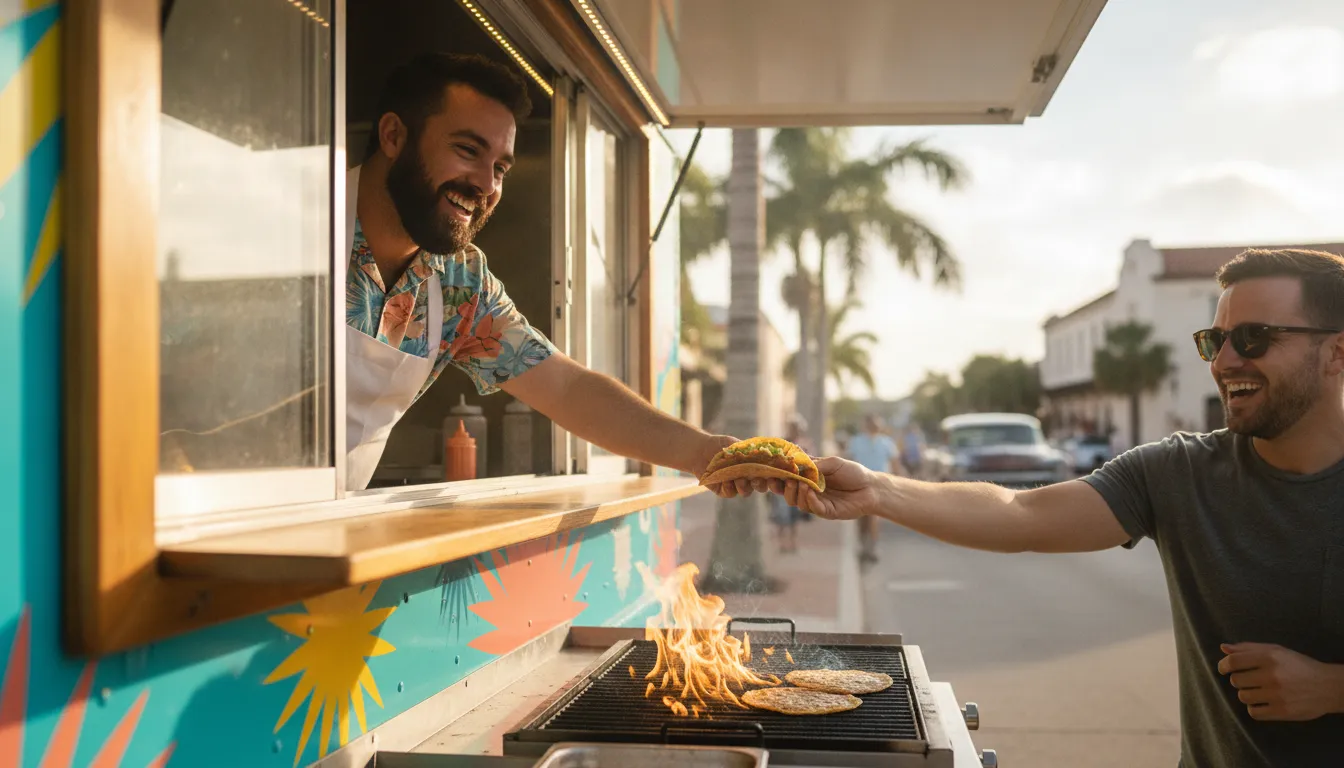
Food Truck Insurance Florida: Coverage & Cost Guide
A food truck can serve a crowded festival one day and sit exposed to traffic, weather, and cooking hazards the next. In Florida, your insurance needs to protect more than the vehicle itself. It should account for business use, customer injuries, equipment, food-related claims, and the rules attached to events and permits.
Food truck insurance Florida typically combines commercial auto, general liability, and property or equipment protection, with product liability and workers’ compensation added when your operations require them. The right limits depend on your truck, build-out, cooking setup, employees, routes, and event contracts.
That combination matters because a personal auto policy may exclude business use, while a single incident can interrupt both transportation and service. Before comparing premiums, start by understanding the distinct risks your mobile kitchen creates and why a standard personal policy is rarely enough.
Why Food Trucks Need Specialized Insurance Coverage in Florida
A Florida food truck is both a commercial vehicle and a working kitchen. A taco truck may spend the morning driving to a festival, the afternoon serving customers, and the evening parked at a storage location. Each setting creates different risks that a personal auto policy or generic business policy may not address.
Personal auto policies generally exclude business use. That matters when your BBQ trailer is headed to an event or your truck is carrying cooking equipment and inventory for a paid service. Commercial auto coverage is designed for business vehicles and can respond to a fender-bender while you are driving to an event. Without it, one routine trip could become a costly dispute over whether the policy applies.
The truck itself is also your place of business. A kitchen fire can put your only unit out of service for weeks, cutting off the revenue you depend on for payroll, permits, supplies, and household expenses. Coverage needs to account for more than the vehicle’s transportation function. The built-in cooking equipment and business property deserve attention during the insurance review.
Customer-facing risks create another gap. Someone could slip near the service window after a spill, trip over an item near the queue, or claim an injury connected with your service area. General liability insurance is intended for these third-party injury and property-damage exposures, while other coverage addresses the truck and its operation.
Florida’s busy event circuits make this distinction practical, not theoretical. A specialized policy can coordinate commercial auto, liability, and equipment protection around how your business actually operates. Whether you run one independent truck or a BBQ trailer that moves between markets all year.
Commercial Auto Insurance for Florida Food Trucks
Your truck is both a vehicle and the place where your business operates. Commercial auto insurance provides the foundation for protecting it while you drive between your commissary, parking location, festivals, and private events. Florida food truck operators need coverage for the vehicle itself and liability arising from accidents during transport. Florida food truck insurance requirements commonly identify commercial auto as a core requirement.
What commercial auto covers
A personal auto policy generally excludes business-related use. That can leave a gap when you are hauling cooking equipment to a festival, driving to a catering job, or moving the truck between locations. Commercial auto coverage is designed for those business trips, including a fender-bender on the way to an event.
Ask how the policy handles physical damage to the truck, liability for an accident, deductibles, and roadside incidents. A taco truck carrying staff and supplies may have different risks from a small coffee cart. Your daily routes, drivers, parking arrangements, and event schedule should be part of the underwriting discussion.
For-hire versus owned vehicles
Tell your agent whether you own the truck, finance it, lease it, or hire another company to transport it. The ownership and use arrangement can affect who needs to be insured and how the vehicle is listed. If you tow a kitchen trailer, include the trailer and explain how it connects to the truck. Do not assume a policy covering the tow vehicle automatically covers the trailer, equipment, or business contents.
The truck’s value includes more than its chassis. A custom kitchen build-out, commercial wiring, refrigeration, ventilation, and propane systems can substantially change its replacement value. Those features also affect the premium because the insurer is evaluating a more specialized vehicle. Keep invoices, photos, maintenance records, and equipment details available so the stated value reflects what you actually operate.
If your operation also uses delivery vans or other commercial vehicles, review trucking insurance considerations alongside your food truck policy. For broader protection across your business, a commercial insurance review can help coordinate auto, liability, and equipment coverage without leaving separate gaps.
General Liability at Florida Events and Venues
General liability helps protect your food truck business from claims involving other people and their property at festivals, markets, and private events. It is different from commercial auto coverage, which addresses driving risks.
What general liability covers
Picture a busy festival where a customer steps away from your service window, slips on a wet surface, and alleges your operation caused the injury. General liability can respond to this type of customer slip-and-fall claim, including related legal defense and covered damages under the policy terms. This is one reason food truck owners should understand what general liability insurance is designed to do.
Coverage can also address certain third-party property damage claims connected to your business. The exact policy exclusions and limits matter, especially if you use fryers, grills, generators, or other equipment near crowded walkways. Ask an insurance professional to review how your setup, service area, and food preparation activities fit the policy.
Florida has no statewide general liability mandate, but most municipalities and event venues require $1 million per occurrence and $2 million aggregate limits. These limits are commonly part of the event’s vendor requirements, not a universal state rule. Review Florida food truck insurance requirements before committing to an event.
Certificates of insurance for events
Event organizers typically request a Certificate of Insurance, or COI, before allowing a food truck to operate. For example, a festival organizer may ask for your COI while finalizing the weekend lineup. The certificate confirms that coverage is in place and shows the limits the organizer requested.
Send the organizer’s requirements to your insurance professional early. The event may request specific wording, an additional insured designation, or separate certificates for a venue and organizer. Coordinating those details before arrival can prevent a last-minute cancellation or delay at check-in.
Workers’ Compensation Requirements for Florida Food Truck Owners
Workers’ compensation protects your crew when someone gets hurt while preparing, serving, or transporting food. A hot-oil burn, knife injury, or slip inside a crowded truck can create medical bills and missed wages. Workers’ comp helps address those costs while protecting your business from handling the entire claim alone.
Do you need workers’ comp with one employee?
Florida generally requires workers’ compensation for food truck businesses with four or more employees. That means a solo owner with one part-time helper may not meet the statewide employee-count threshold. But the answer can change as your crew grows or your business structure changes. Review the requirement before adding another cashier, cook, or event worker, rather than waiting until an organizer or employee asks for proof.
An owner who holds at least 10% ownership in the company may elect an exemption from workers’ compensation coverage. That exemption applies to the qualifying owner, not to regular employees. If your taco truck has three employees and you are the owner, you cannot simply exclude those employees because you plan to waive coverage for yourself. Confirm the ownership and exemption paperwork before relying on it.
How much does coverage cost?
For Florida food truck employees, workers’ compensation is commonly estimated at about $1.03 per $100 of payroll, plus taxes and fees. Another estimate places the cost near $30 per employee each month. Your actual premium depends on payroll, job classifications, claims history, and the insurer’s underwriting.
For a small crew, the premium may be a manageable operating expense compared with the cost of an uninsured injury. Our guide to workers comp cost in Florida can help you review the factors that affect your estimate.
Why compliance matters
Operating without required coverage can expose a food truck to stop-work orders, fines, and lawsuits. A missed festival weekend can affect payroll, inventory, and customer relationships. Keep your policy information current, and ask your agent whether new employees, seasonal event staff, or changes in ownership require an update.
Review the Florida workers’ compensation requirements and confirm your setup with a licensed insurance professional before your next event.
How Much Does Food Truck Insurance Cost in Florida?
For a single-truck operator, food truck insurance in Florida typically runs about $2,000 to $8,000 per year as of 2026. That range is a planning estimate, not a guaranteed quote. A coffee cart with limited cooking equipment presents a different risk than a barbecue truck using fryers, propane, and a larger built-out kitchen. Pricing factors include commercial auto coverage, truck value and build-out, cooking risk, and overnight parking.
National averages can help you understand how individual coverages contribute to the total. Insureon reports the following monthly averages for food truck businesses:
| Coverage. | What it generally addresses. | National average per month. |
|---|---|---|
| Business owner’s policy (BOP). | Combines general liability with eligible business property protection. | $84 |
| General liability. | Third-party injury or property damage claims, such as a slip near the service window. | $42 |
| Workers’ compensation. | Work-related employee injuries, medical care, and lost wages. | $78 |
| Liquor liability. | Claims connected with serving or selling alcoholic beverages. | $58 |
These figures are national averages, so they should not be treated as Florida quote prices. They also do not represent a package every food truck needs. For example, liquor liability may be unnecessary for a taco truck that never serves alcohol, while workers’ compensation depends on your employee count and payroll.
Florida premiums can rise when the truck has expensive cooking equipment, a complex build-out, high-value inventory, or a menu involving deep frying and open flames. Parking overnight in an unsecured location may also affect underwriting. Your event schedule matters as well. A truck working frequent festivals, private events, or crowded markets may need specific limits, additional insureds, or certificates of insurance for organizers.
When comparing quotes, ask each broker to show the limits, deductibles, endorsements, and exclusions rather than comparing only the monthly premium. A lower price may provide less protection for the vehicle, kitchen equipment, or products you serve. Insureon’s food truck cost data can provide a national reference point, while a Florida broker can match the policy to your truck, menu, parking arrangements, and event calendar.
Equipment Breakdown, Property and Product Liability Protection
Your food truck is both a kitchen and a revenue-producing vehicle. A serious equipment failure can stop service before the next festival, while a claim involving the food you served can continue long after the customer leaves. A practical coverage plan protects the tools, ingredients, and people connected to your operation.
Equipment breakdown and spoilage coverage
Equipment protection can cover kitchen tools and built-out units, including the fryer, cooking equipment, prep surfaces, and refrigeration installed in the truck. It is worth discussing separately from commercial auto because an auto policy is designed around driving risks, not every loss involving the mobile kitchen.
Consider a fryer failure during a busy weekend or a refrigerator that stops working on a hot Florida day. Spoiled seafood, meat, dairy, and prepared ingredients can create an immediate inventory loss. Depending on the policy, equipment breakdown and property coverage may help address repair or replacement costs, and spoilage coverage may address damaged food. Ask exactly which causes of loss, deductibles, and limits apply before choosing a policy.
Kitchen fires deserve the same attention. A fire can park your only unit for weeks, creating repair costs and lost operating time. Review the value of the truck, its build-out, and the equipment inside it so the limits reflect what you would actually need to replace.
For a deeper explanation of this coverage, review our equipment breakdown insurance guide.
Product liability for food-borne illness claims
General liability helps address many third-party injury claims, but food businesses should also consider product liability. A customer with a seafood allergy, for example, could claim that a meal caused an illness or allergic reaction. Product liability is recommended alongside general liability, commercial auto, and equipment protection for a more complete food truck insurance program. Coverage guidance for Florida food trucks also identifies this combination as a practical starting point.
Tell your broker what you serve, how you store ingredients, whether you cater private events, and whether another business supplies any prepared food. Those details help match liability limits and exclusions to the way your truck actually operates.
Florida Permits, Certificates of Insurance and Event Compliance
Use the same checklist for a neighborhood food festival, a private catering booking, or a campus event. Starting early gives you time to correct a permit or insurance issue before it costs you a service date.
-
Confirm the right mobile food vendor permit
Start by identifying which Florida agency regulates your operation. Food truck owners generally need a mobile food vendor permit from the Florida Department of Business and Professional Regulation (DBPR) or the Florida Department of Agriculture and Consumer Services (FDACS), depending on the food type. Confirm the applicable requirements before accepting bookings, since your menu and preparation method can affect the agency involved. See the Florida food truck permit guidance for an overview, then verify current requirements directly with the appropriate agency.
-
Put the required insurance in place
Ask the event organizer what coverage limits and endorsements the venue requires before you select a policy. Many Florida municipalities and event venues ask for general liability limits of $1 million per occurrence and $2 million aggregate. Your policy should also reflect how you operate, including the truck itself, business driving, food service, and any employees. A personal auto policy generally is not designed for business use, so do not assume it protects the truck while traveling to an event.
-
Request a certificate of insurance
A Certificate of Insurance, or COI, summarizes your active coverage for a third party. Event organizers typically request one before allowing a food truck to operate at a festival, market, or private event. Give your insurance professional the organizer’s exact legal name, address, event dates, and any additional-insured wording the venue provides. A COI is not a substitute for insurance, and an inaccurate certificate can delay approval.
-
Coordinate documents with the event organizer
Send the permit information and COI together, and ask whether the organizer has additional rules for arrival, parking, fire safety, waste handling, or service hours. Coordinate permits and COI documentation with the organizer rather than waiting for the event week. Keep copies in your truck and in a shared digital folder so a manager can produce them quickly if venue staff asks.
-
Check special venue deadlines
Some locations impose stricter screening and lead times. For example, the University of Florida requires mobile food suppliers to be on an approved list and to provide proof of minimum insurance. Its event permit request must include the mobile food supplier request at least 21 business days before the event. Treat that as a planning example, not a statewide deadline. Ask each venue for its own schedule and submit early enough to resolve questions.
Review the checklist whenever your menu, truck, business entity, employees, or event locations change. Those changes can affect both licensing and the documentation an organizer expects.
Frequently Asked Questions
How much does food truck insurance cost in Florida?
For a single-truck operator, a typical annual range is $2,000 to $8,000 in 2026. Your quote can vary based on the truck’s value and build-out, commercial auto exposure, cooking risks, and where the truck is parked overnight. A coffee cart and a full kitchen truck may not carry the same risk profile. See the Florida cost factors.
What insurance is required for a food truck in Florida?
Commercial auto coverage is required for the truck and its liability while traveling. Florida food truck operators also need a mobile food vendor permit through the Department of Business and Professional Regulation or the Florida Department of Agriculture and Consumer Services, depending on the food they serve. Review the Florida requirements.
How much general liability coverage do Florida food trucks need?
There is no statewide general liability mandate, but most Florida municipalities and event venues commonly require $1 million per occurrence and $2 million aggregate. General liability can address risks such as a customer slipping near your service window. Event organizers may also request a Certificate of Insurance before approving your truck.
Do food trucks in Florida need workers’ compensation insurance?
Florida generally requires workers’ compensation coverage when a food truck business has four or more employees. An owner with at least 10 percent ownership may elect an exemption for themselves, but regular employees cannot be excluded. The coverage can help pay medical bills and lost wages after a workplace injury. Check the workers’ compensation guidance.
Get started with the right food truck coverage
Your coverage should reflect how your truck operates, from driving between events to serving customers at a busy festival. A Florida-based advisor who works with multiple carriers can help you review commercial auto, general liability, property, and workers’ compensation together, so no exposure falls between policies.
Get a commercial insurance quote or call 786-344-9343 to talk through your truck, build-out, menu, and event schedule. Schedule an appointment if you prefer to review your options in person.
Comments
Comments are closed.