
The Strategic Guide to Restaurant Insurance
You know that every dollar counts when running your restaurant. But viewing insurance as just another expense is a critical mistake. The right coverage is a strategic investment in your future. A single kitchen fire or customer lawsuit can create costs that wipe out your hard-earned profits overnight. A proper restaurant insurance strategy isn’t about the monthly premium; it’s about preventing catastrophic loss. It covers everything from slip-and-fall accidents to specific risks like liquor liability insurance and even special occasions requiring event insurance coverage.
Need restaurant insurance? Contact Insurance Underwriters or call 305-900-2823 to speak with a commercial risk advisor who specializes in hospitality coverage.
Restaurant insurance is not a single policy. It is a package of coverages tailored to the specific risks your restaurant faces based on its size, location, cuisine type, alcohol service, delivery operations, and number of employees. This guide covers every type of coverage you need, what each policy protects, how much restaurant insurance costs, and how to build a comprehensive protection strategy for your food business.
Key Takeaways
- Restaurant insurance typically costs between $3,000 and $10,000 per year, depending on your restaurant’s size, revenue, location, and risk profile.
- Every restaurant needs at minimum general liability insurance, commercial property insurance, and workers’ compensation insurance.
- Restaurants that serve alcohol must carry liquor liability insurance, which covers claims arising from intoxicated patrons.
- A business owners policy (BOP) bundles general liability, property, and business interruption coverage at a discounted rate.
- Food contamination coverage protects against losses from foodborne illness outbreaks and spoiled inventory.
- Florida restaurants face specific requirements, including mandatory workers’ compensation for businesses with four or more employees.
- Insurance Underwriters helps restaurant owners across the United States build customized coverage packages that address every layer of hospitality risk.
What Does Restaurant Insurance Actually Cover?
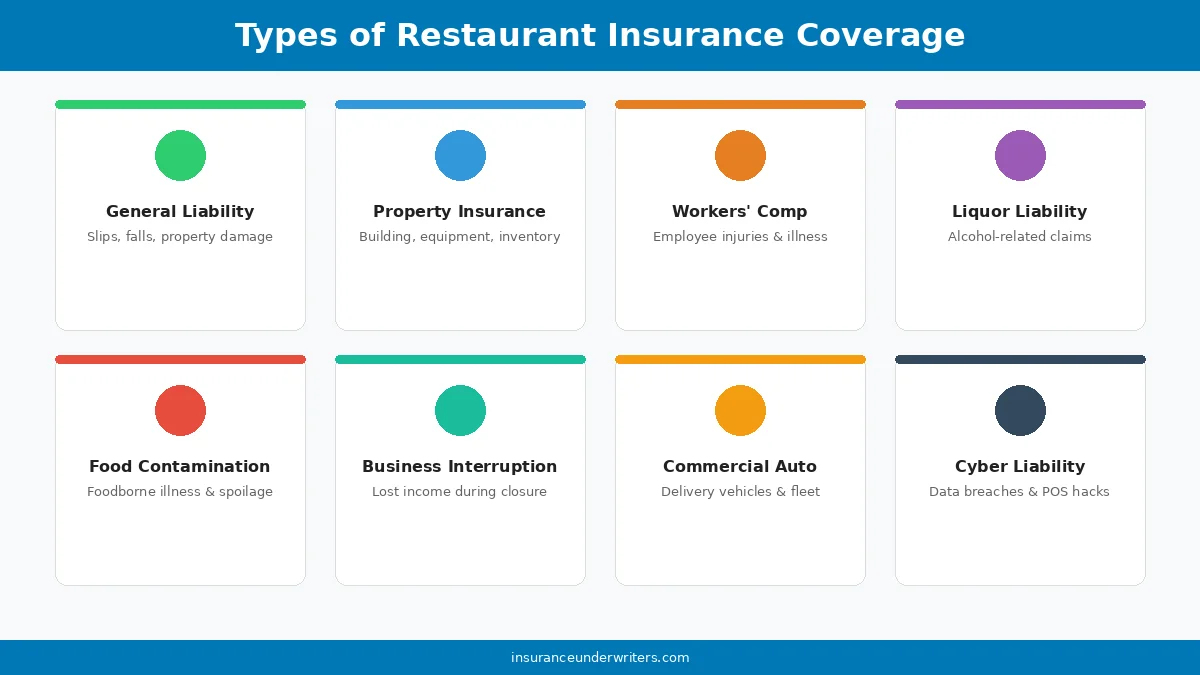
Restaurant insurance is a collection of commercial policies that protect food service businesses from financial losses caused by lawsuits, property damage, employee injuries, food safety incidents, and operational disruptions. Insurance Underwriters provides customized restaurant insurance packages covering general liability, commercial property, workers’ compensation, liquor liability, food contamination, business interruption, commercial auto, and cyber liability for restaurants across the United States.
The restaurant industry operates in one of the highest-risk environments for commercial insurance. The National Restaurant Association reports that there are over 1 million restaurant locations in the United States, and the industry generates over $1 trillion in annual sales. With that scale comes enormous exposure: hot kitchens, heavy foot traffic, alcohol service, perishable inventory, delivery operations, and large workforces all create overlapping liability scenarios.
Restaurant insurance transfers these financial risks from your business to an insurance carrier. Instead of paying $150,000 out of pocket for a customer injury lawsuit, your general liability policy covers the legal defense and settlement. Instead of absorbing the full cost of a kitchen fire, your commercial property insurance pays to rebuild and replace equipment. Instead of shutting down permanently after a food contamination incident, your coverage pays for remediation, legal defense, and lost income during the closure.
What Types of Food Businesses Need Insurance?
If your business prepares, serves, or sells food, you need insurance. It’s that simple. The specific blend of policies will change based on your unique operation, but the fundamental need for protection is universal. From a small pop-up coffee stand to a multi-state restaurant franchise, every food business faces significant daily risks. A customer could slip on a wet floor, an employee could get burned in the kitchen, or a power outage could spoil thousands of dollars worth of inventory. Without the right coverage, a single incident could threaten your financial stability. The key is to work with an advisor who can identify your specific exposures and build a policy package that protects your assets, employees, and reputation.
From Food Trucks to Fine Dining
The term “restaurant” covers a massive range of business models, and nearly all of them require a safety net. Most businesses that cook and serve food—whether it’s a quick bite or a five-course meal—need comprehensive coverage. This includes traditional establishments like family-style restaurants, diners, delis, and fine-dining venues. It also extends to fast-food franchises, pizzerias, sandwich shops, and cafes. Even more specialized food businesses like caterers, concession stands, juice bars, and food trucks share the same core risks of liability, property damage, and employee injury. No matter your menu or service style, if you are part of the food service industry, a tailored insurance plan is an essential ingredient for long-term success.
Special Cases: Ghost Kitchens, Lounges, and Suppliers
Modern food business models introduce new layers of risk that demand specialized coverage. For example, ghost kitchens, which operate for delivery only without a public storefront, still face major exposures from kitchen fires, food contamination, and employee injuries. They also have unique liabilities tied to their reliance on third-party delivery drivers. Bars, taverns, and lounges that serve alcohol must carry liquor liability insurance, a critical policy that protects them from claims arising from the actions of intoxicated patrons. Even restaurant suppliers need protection, as a product liability policy can shield them from lawsuits if their ingredients are linked to a foodborne illness outbreak. Each of these businesses requires a thoughtful approach to risk management that goes beyond a standard policy.
What Insurance Policies Does Your Restaurant Need?
Every restaurant faces a unique combination of risks based on its format, location, and operations. The coverage types below represent the essential policies that most restaurant owners need. Your specific situation determines the exact combination and coverage limits.
What Does General Liability Cover?
General liability insurance is the foundation of every restaurant insurance program. It covers third-party bodily injury, property damage, and advertising injury claims. When a customer slips on a wet floor, burns themselves on a hot plate, or trips over a loose carpet edge, general liability pays the medical bills, legal defense costs, and any settlements or judgments.
Standard policies provide $1 million per occurrence and $2 million in aggregate coverage. For restaurants, general liability typically costs between $2,000 and $5,000 per year, higher than many other small businesses because of the elevated foot traffic and injury risk inherent in food service environments.
Every restaurant needs general liability coverage regardless of size. Landlords require it before signing a lease. Event venues require it before allowing catering. Vendors and suppliers often require proof of coverage before entering contracts.
Protection from Common Customer Incidents
Your restaurant is a hub of activity, which unfortunately means the risk of a customer getting hurt is always present. From a simple slip on a wet floor to a trip over a misplaced bag, these common incidents can quickly escalate into costly claims. This is where your insurance strategy becomes critical. A comprehensive restaurant insurance plan is designed to shield your business from the financial fallout of these events. General liability coverage acts as your first line of defense, stepping in to handle medical expenses and legal fees if a customer is injured on your property. It’s the policy that lets you focus on running your business, knowing you have a safety net for the unpredictable moments that come with serving the public.
Specific Risks: Allergic Reactions and Burns
Beyond slips and falls, restaurants face unique liability risks tied directly to their food and service. A customer could suffer a severe allergic reaction due to cross-contamination, or a server might accidentally spill a hot liquid, causing a burn. Even with rigorous staff training and clear menu warnings, these accidents can happen. Your general liability policy is built to respond to these exact scenarios. As the foundation of your insurance program, it covers third-party bodily injury claims, paying for the associated medical bills, legal defense, and potential settlements. This protection is essential for managing the inherent risks of a fast-paced kitchen and dining room environment, ensuring one incident doesn’t jeopardize your entire operation.
What Does Commercial Property Insurance Protect?
Commercial property insurance protects your restaurant’s physical assets: the building (if you own it), kitchen equipment, furniture, fixtures, signage, point-of-sale systems, inventory, and any other business personal property. It covers losses from fire, storms, theft, vandalism, electrical failure, and other covered perils.
Restaurant property coverage is critical because of the high replacement cost of commercial kitchen equipment. A single commercial oven can cost $10,000 to $50,000. Walk-in coolers, ventilation systems, dishwashing stations, and specialty cooking equipment add up quickly. A total kitchen fire loss at a mid-sized restaurant can easily exceed $500,000.
Coverage limits should match the full replacement cost of your total physical assets. Annual premiums typically range from $2,000 to $6,000 depending on property value, building construction, fire suppression systems, and location.
Coverage for Stolen Cash and Business Papers
Restaurants handle a lot of cash, making them a target for theft. While your main commercial property policy protects your big-ticket items, it often provides very limited coverage for cash stolen from the premises—sometimes as little as a few hundred dollars. This is rarely enough to cover the loss from a register or safe. To properly protect your cash flow, you need a specific endorsement for money and securities. This add-on increases the coverage limits for cash, checks, and other financial instruments, whether they are on-site, at your home, or in transit to the bank. It’s a crucial piece of a complete commercial property insurance strategy, ensuring a robbery doesn’t wipe out your working capital. This coverage can also extend to the cost of recreating essential business papers and records lost in a fire or theft.
Is Workers’ Compensation Required?
Workers’ compensation insurance covers medical expenses, rehabilitation costs, and a portion of lost wages when an employee suffers a work-related injury or illness. Restaurant workers face elevated injury risks from cuts, burns, slips, repetitive strain, and heavy lifting.
Workers’ compensation is legally required in nearly every state once you have employees. In Florida, businesses with four or more employees must carry workers’ comp coverage. The restaurant industry has one of the highest workers’ compensation claim rates of any sector, which means premiums tend to run higher, typically $3,000 to $8,000 per year for a restaurant with 15 to 30 employees.
Beyond legal compliance, workers’ compensation protects your business from employee injury lawsuits. Without coverage, a single serious burn or fall injury could result in a six-figure lawsuit that threatens your restaurant’s survival.
How Workers’ Comp Premiums Are Calculated
Workers’ comp premiums aren’t a flat fee; they’re calculated based on a specific formula. Insurers start with your total employee payroll and multiply it by a rate assigned to different job classifications, or “class codes.” In a restaurant, a line cook faces different risks than a server, so they have different class codes and rates. Your business’s unique claims history is then factored in through an “experience modification rate” (e-mod). If you have a strong safety record with fewer claims than the industry average, you can earn a credit that lowers your premium. Conversely, a history of frequent injuries will increase your costs. This is why actively managing workplace safety is one of the most effective ways to control your workers’ compensation costs and protect your bottom line.
Serving Alcohol? Don’t Forget Liquor Liability
If your restaurant serves beer, wine, or spirits, liquor liability insurance is essential. This coverage protects against claims arising from the actions of intoxicated patrons, including drunk driving accidents, fights, property damage, and injuries caused by customers who were overserved.
Liquor liability is separate from general liability because alcohol-related claims carry significantly higher legal exposure. A drunk driving fatality linked to overservice at your restaurant could result in a multi-million dollar lawsuit. Standard general liability policies exclude or severely limit alcohol-related claims.
Premiums depend heavily on the percentage of your revenue that comes from alcohol sales. A restaurant where alcohol represents 15% of revenue will pay significantly less than a bar or nightclub where alcohol is 60% or more of revenue. Expect to pay $1,000 to $5,000 per year for restaurant-level liquor liability coverage.
Understanding State “Dram Shop” Laws
Many states have what are known as “dram shop” laws, which hold businesses that serve alcohol financially responsible for the actions of intoxicated patrons. If a customer you served causes a drunk driving accident, gets into a fight, or damages property, your restaurant can be sued for contributing to their intoxication. These lawsuits are notoriously expensive, with a single fatality potentially leading to a multi-million dollar judgment against your business. It’s crucial to understand that your standard general liability policy almost certainly excludes these alcohol-related incidents. To cover this gap, you need a specific liquor liability insurance policy. This isn’t just about following best practices; it’s a fundamental step to protect your restaurant from a single event that could otherwise be financially catastrophic.
What if Your Food Spoils? Understanding This Coverage
Food contamination coverage, sometimes called food spoilage insurance, protects your restaurant from losses related to foodborne illness outbreaks, contaminated ingredients, and spoiled inventory. This includes the cost of disposing contaminated food, deep cleaning the facility, legal defense against customer illness claims, and lost revenue during a health department closure.
A single norovirus outbreak can force a restaurant to close for days or weeks while the source is identified and the facility is sanitized. The direct costs of disposal, cleaning, and lost perishable inventory are compounded by the reputational damage and lost revenue. Food contamination coverage addresses all of these losses.
This coverage also protects against equipment breakdown scenarios, such as a walk-in cooler failure that spoils $20,000 worth of inventory overnight. Some policies bundle equipment breakdown coverage with food spoilage, while others offer them separately.
What If You Have to Temporarily Close?
Business interruption insurance replaces lost income and covers ongoing fixed expenses when a covered event forces your restaurant to close temporarily. If a fire, flood, or major equipment failure shuts down your kitchen for three months, business interruption coverage pays your rent, loan payments, payroll for key employees, and the income your restaurant would have earned during the closure period.
Looking for a business interruption quote for your restaurant? Get a free coverage analysis from Insurance Underwriters today.
This coverage is typically included in a business owners policy (BOP) but can also be purchased as a standalone policy. The coverage limit should reflect your restaurant’s monthly fixed expenses and average revenue. Most restaurants need at least 6 to 12 months of business interruption coverage to survive a major loss event.
Bundling Coverage: The Business Owner’s Policy (BOP)
A business owners policy bundles general liability, commercial property, and business interruption coverage into a single, discounted package. For many restaurant owners, a BOP provides the broadest foundation of coverage at the lowest cost.
BOPs typically cost between $2,000 and $5,000 per year for restaurants, which is significantly less than purchasing each component separately. The bundled approach also simplifies administration since you deal with one policy, one premium, and one renewal date instead of three.
Most restaurants with fewer than 100 employees and less than $5 million in annual revenue qualify for a BOP. Larger or higher-risk operations may need to purchase standalone policies for each coverage type.
What a BOP Can Include
A Business Owner’s Policy, or BOP, is a smart way to package essential insurance for your restaurant. It combines three core coverages into a single policy: general liability, commercial property, and business interruption. Think of it as the foundational layer of your risk management strategy. The general liability part protects you from customer injury claims, like a slip-and-fall. Commercial property covers your physical assets—the building, kitchen equipment, and inventory—from events like fire or theft. And business interruption steps in to replace lost income and cover ongoing expenses if a covered disaster forces you to close temporarily. For many restaurants, a BOP offers the broadest initial protection at a much lower cost than buying each policy on its own.
A Word of Caution on Bundled Policies
While a BOP is an efficient and cost-effective starting point, it’s critical to recognize what it doesn’t cover. The convenience of a single policy is appealing, but it’s not an all-in-one solution. A standard BOP will not protect you from some of a restaurant’s biggest risks. For instance, it almost always excludes workers’ compensation for employee injuries, liquor liability for incidents involving intoxicated patrons, and commercial auto insurance for your delivery vehicles. Relying solely on a BOP without reviewing your specific operations can leave you with serious financial gaps. The key is to use the BOP as a base and then work with an advisor to add the specific policies and endorsements needed to create a truly comprehensive safety net.
Do You Use a Vehicle for Business?
If your restaurant operates delivery vehicles, catering vans, or company cars, commercial auto insurance is required. This covers vehicle damage, driver injuries, and third-party liability from accidents involving your business vehicles.
With the growth of in-house delivery services, more restaurants need commercial auto coverage than ever before. Even if your drivers use personal vehicles for deliveries, you may need hired and non-owned auto coverage to protect your restaurant from liability if a delivery driver causes an accident while working.
Protecting Customer Data: Cyber Liability Insurance
Cyber liability insurance protects your restaurant from data breaches, ransomware attacks, and other cybersecurity incidents. Restaurants process thousands of credit card transactions daily through POS systems, making them frequent targets for hackers.
A data breach that exposes customer payment information can trigger costly notification requirements, credit monitoring obligations, regulatory fines, and lawsuits. Cyber liability coverage pays for forensic investigation, customer notification, legal defense, and regulatory compliance costs. Premiums for restaurants typically range from $500 to $2,000 per year.
What Is Employment Practices Liability (EPLI)?
Employment practices liability insurance protects your restaurant from employee claims of discrimination, harassment, wrongful termination, and wage violations. The restaurant industry has one of the highest rates of employment-related lawsuits, driven by high employee turnover, tip disputes, and workplace harassment claims.
A single wrongful termination lawsuit can cost $75,000 to $200,000 in legal defense and settlement costs, even if the claim is ultimately dismissed. EPLI coverage is increasingly important as employment law becomes more complex and employee awareness of their rights increases.
Umbrella Insurance: An Extra Layer of Protection
Think of your general liability and commercial auto policies as your first line of defense. But what happens when a claim is so large it exhausts those policy limits? A catastrophic lawsuit, like one from a severe liquor liability incident, can easily cost more than a standard $1 million policy. This is where commercial umbrella insurance provides a critical safety net. It adds an extra layer of liability coverage, typically in $1 million increments, on top of your existing policies.
Umbrella insurance provides additional liability coverage beyond the limits of your existing policies. It can help protect your restaurant from large claims that exceed your general liability or other insurance limits, ensuring that you have sufficient coverage in case of a major incident. For a relatively low cost, an umbrella policy can be the difference between surviving a massive lawsuit and facing financial ruin. It’s a strategic purchase for any restaurant owner who wants to secure their business for the long term.
Product Liability for Restaurant Retail
If your restaurant has expanded into selling retail items, you’ve opened up a new revenue stream—and a new area of risk. Selling your signature BBQ sauce, packaged coffee beans, or even branded merchandise means you are now a product producer. Should a customer get sick from a packaged food item or have an allergic reaction to a lotion you sell, your standard general liability policy may not cover it. This is because the harm didn’t happen on your premises but from a product you sold.
Product liability insurance is essential for restaurants that sell retail items, such as packaged foods or merchandise. This coverage protects against claims arising from injuries or damages caused by products sold by your restaurant. It ensures that you are covered in case a customer suffers harm from a product you provided, protecting your business from the unique liabilities that come with putting your brand on a shelf.
Employee Theft Coverage
It’s an uncomfortable reality, but employee dishonesty is a significant risk in the restaurant industry. With high volumes of cash transactions and valuable inventory, the opportunity for theft is always present. This can range from an employee skimming cash from the register to a manager falsifying records to steal expensive food and liquor. These small, repeated losses can add up to a substantial financial hit over time. Standard property insurance policies almost always exclude losses from employee theft, leaving you to absorb the cost yourself.
Employee theft coverage, often included in a commercial crime policy, protects your restaurant from financial losses due to dishonest acts by employees. This type of insurance is crucial for safeguarding your business assets and ensuring that you can recover from any losses incurred due to employee misconduct. It’s a vital protection for an industry built on trust but vulnerable to internal threats.
Life Insurance for Business Owners
For many restaurants, the owner or head chef is the heart and soul of the operation. Their vision, recipes, and leadership are the business’s most valuable assets. But what would happen to the restaurant if you were no longer there? Life insurance for business owners is a strategic tool for ensuring the business can survive and thrive even after your death. The proceeds can be used to pay off business debts, provide the capital to hire and train a replacement, or fund a buy-sell agreement so your partners can buy out your share from your heirs.
Life insurance can provide financial security for your family and business in the event of your untimely death. This coverage can help cover business debts, ensure continuity, and provide for your loved ones, making it an important consideration for restaurant owners who are building a lasting legacy, not just a business.
Legally Required Insurance Policies
While most of the coverages we’ve discussed are strategic choices to manage risk, some are not optional. Federal and state laws mandate that businesses carry certain types of insurance to protect their employees and the public. Failing to secure legally required coverage can result in severe penalties, including heavy fines, business closure orders, and even criminal charges. The specific requirements vary by state, but two policies are nearly universal for any restaurant with employees.
In most states, certain types of insurance are legally required for restaurants, including workers’ compensation and unemployment insurance. These policies protect both employees and employers, ensuring that workers are compensated for job-related injuries and that businesses comply with state regulations. Understanding these non-negotiable coverages is the first step in building a compliant insurance program.
Unemployment Insurance
Unemployment insurance is a state-administered program that provides temporary financial assistance to employees who lose their jobs through no fault of their own. As a restaurant owner, you don’t buy this policy from an agent; instead, you pay unemployment taxes to the state. These funds are then used to pay benefits to former employees who have been laid off. It’s a fundamental part of the social safety net and a required cost of having employees. Complying with these laws is essential for supporting your workforce and operating a legal, responsible business.
What Will Restaurant Insurance Cost You?
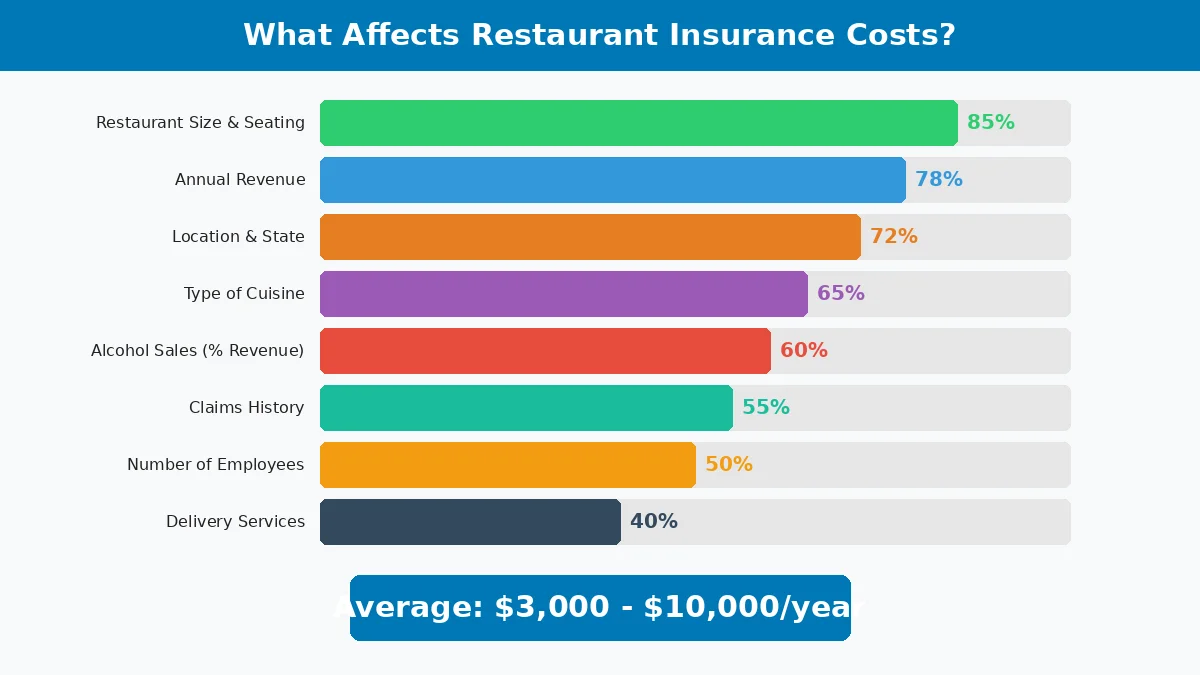
Restaurant insurance typically costs between $3,000 and $10,000 per year for a comprehensive coverage package. Insurance Underwriters helps restaurant owners determine the right coverage levels based on their restaurant’s size, revenue, location, cuisine type, alcohol sales volume, claims history, number of employees, and delivery operations to build a cost-effective protection strategy.
Here is a breakdown of typical annual costs by coverage type:
| Coverage Type | Average Annual Cost |
|---|---|
| General Liability | $2,000 – $5,000 |
| Commercial Property | $2,000 – $6,000 |
| Workers’ Compensation | $3,000 – $8,000 |
| Liquor Liability | $1,000 – $5,000 |
| Food Contamination | $500 – $2,000 |
| Business Interruption | $750 – $2,500 |
| Commercial Auto | $1,200 – $4,000 |
| Cyber Liability | $500 – $2,000 |
| EPLI | $800 – $3,000 |
| BOP (GL + Property + BI bundle) | $2,000 – $5,000 |
Average Monthly Cost of Restaurant Insurance
So, what’s the bottom line? On average, restaurant owners can expect to pay between $250 and $833 per month for their insurance package. This translates to an annual cost of roughly $3,000 to $10,000. Think of this as a ballpark figure. Your final premium depends entirely on your unique situation—factors like your restaurant’s size, annual revenue, location, and specific risk profile all play a significant role. For example, a small café will have a very different cost structure than a large fine-dining establishment with a full bar. The key is to build a plan that matches your specific operational risks without overpaying for unnecessary coverage.
Sample Costs by Policy Type
To give you a clearer picture of how that total cost breaks down, here are the typical annual premium ranges for the essential policies most restaurant owners need. Remember, these are estimates, but they can help you budget accordingly. A Business Owner’s Policy (BOP) is often the most cost-effective starting point, bundling several key coverages together.
- General Liability: $2,000 – $5,000
- Commercial Property: $2,000 – $6,000
- Workers’ Compensation: $3,000 – $8,000
- Liquor Liability: $1,000 – $5,000
- Food Contamination: $500 – $2,000
- Business Interruption: $750 – $2,500
- Commercial Auto: $1,200 – $4,000
- Cyber Liability: $500 – $2,000
- Employment Practices Liability (EPLI): $800 – $3,000
- Business Owner’s Policy (BOP): $2,000 – $5,000
These figures can certainly shift based on your restaurant’s claims history, the coverage limits you choose, and your deductible amounts. A clean record and higher deductibles can lower your premiums, while a history of claims will likely increase them. The best way to understand your exact costs is to work with a professional who can see the full picture. A risk advisor can analyze your restaurant’s specific needs, identify potential discounts, and help you build a strategic insurance plan that finds the right balance between comprehensive protection and value.
What Determines Your Restaurant Insurance Cost?
Restaurant size and seating capacity. A 30-seat cafe pays less than a 200-seat banquet hall. More seats mean more foot traffic, higher revenue exposure, and greater injury risk.
Annual revenue. Insurance carriers use revenue as a proxy for overall risk exposure. Higher revenue generally means higher premiums, but it also means you have more to protect.
Location. Restaurants in high-crime areas, flood zones, or regions with high litigation rates pay more. Florida restaurants face hurricane and flood exposure that increases property premiums.
Type of cuisine. Restaurants with extensive frying, open-flame cooking, or wood-fired ovens carry higher fire risk and may pay more for property coverage.
Alcohol sales as a percentage of revenue. Higher alcohol revenue increases liquor liability premiums significantly.
Claims history. A clean claims record earns better rates. Restaurants with multiple prior claims face higher premiums or may struggle to find coverage.
Number of employees. More employees mean higher workers’ compensation premiums and greater EPLI exposure.
Delivery operations. Restaurants with in-house delivery services need commercial auto coverage and face higher general liability exposure from off-premises incidents.
Ready to find out what restaurant insurance will cost for your business? Contact Insurance Underwriters at 305-900-2823 for a free, no-obligation coverage analysis.
How State Regulations Impact Your Premiums
Where you set up shop has a major impact on your insurance costs because insurance is regulated at the state level. This means requirements for policies like workers’ compensation can vary, as can the factors that influence your rates. For example, restaurants in regions with high litigation rates often pay more for liability coverage. Location-specific risks also play a huge role. As an example, Florida restaurants face hurricane and flood exposure that increases property premiums. An experienced advisor can help you understand the specific regulations and environmental risks in your state that will affect your final insurance cost.
The Role of Deductibles in Your Policy
Your deductible is the amount of money you agree to pay out-of-pocket for a claim before your insurance coverage begins. Think of it as your share of the risk. Choosing a higher deductible will typically lower your annual premium, which can be tempting for managing cash flow. However, it also means you’ll have a larger expense to cover if you need to file a claim. Conversely, a lower deductible means a higher premium but less financial strain when an incident occurs. The key is to select a deductible amount that you could comfortably pay on short notice without disrupting your business operations.
How Your Business Model Affects Your Rate
Insurance carriers look at your specific business model to gauge your level of risk. For instance, a fine-dining restaurant with high-value decor and expensive wine cellars has a different property risk profile than a quick-service cafe. A sports bar that does 50% of its sales in alcohol has a much higher liquor liability risk than a family diner that only serves beer and wine. Insurers use your annual revenue as a general indicator for your overall risk exposure. While higher revenue often leads to higher premiums, it’s important to remember that it also means you have a more valuable business to protect.
Considerations for New Restaurants
For new restaurant owners, securing insurance is a foundational step, not an afterthought. Since you don’t have a claims history for an underwriter to review, they will look closely at your business plan, your personal experience in the industry, and the safety measures you plan to implement. It’s critical to get this right from the start. Without proper coverage, a single serious burn or fall injury could result in a six-figure lawsuit that threatens your restaurant’s survival before it even has a chance to thrive. Working with an advisor who specializes in hospitality can ensure you don’t have any critical gaps in your initial policy.
Adjustments for Seasonal Operations
If your restaurant operates seasonally, like a beachside grill or a ski-resort cafe, your insurance can be structured to reflect that. While you’ll need to maintain commercial property coverage year-round to protect your building and equipment, other policies can be more flexible. For example, your workers’ compensation premiums are based on payroll, so they will naturally decrease during your off-season. It’s also vital to maintain business interruption coverage year-round. If a fire occurs in the off-season, this policy ensures you have the funds to rebuild and cover the income you would have earned during your busy period.
Unique Needs for Catering Businesses
Catering businesses face a unique set of risks because their operations are mobile. Your general liability policy needs to cover incidents that happen at client venues, not just at your home base. Transporting food, equipment, and staff also introduces significant auto-related risks. Even if your drivers use their personal vehicles for deliveries, you will likely need hired and non-owned auto coverage to protect your business from liability if an employee causes an accident while working. You may also need extra property coverage, known as inland marine insurance, to protect expensive equipment while it’s in transit or at an event location.
How to Lower Your Insurance Premiums
While insurance is a necessary expense, your premiums are not set in stone. You can directly influence your costs by taking a strategic approach to risk management. Insurance carriers reward businesses that actively work to prevent claims. By implementing and documenting strong safety protocols, you demonstrate that your restaurant is a lower-risk operation, which can lead to more favorable premiums over time. Think of it as investing in safety to generate a return in the form of lower insurance costs and a more resilient business.
Implement Key Risk Management Practices
The most effective way to lower your insurance premiums is to reduce the likelihood of a claim happening in the first place. This starts with creating a culture of safety that is visible in your daily operations. Simple but consistent practices, like training all staff on proper spill cleanup procedures, ensuring walkways are always clear of hazards, and regularly inspecting your premises for potential risks, make a significant difference. Documenting these procedures and your training efforts provides tangible proof to your insurance carrier that you are serious about safety. A proactive risk management plan not only helps control your insurance costs but also protects your employees, your customers, and your restaurant’s reputation.
Staff Training and Certifications
A well-trained team is your first line of defense against liability claims. Requiring staff to obtain specific certifications is a powerful way to formalize your commitment to safety and potentially earn discounts on your premiums. For example, if you serve alcohol, having your servers complete an alcohol safety program like ServSafe or TIPS demonstrates that you are taking proactive steps to prevent overservice and reduce your liquor liability exposure. The same principle applies to food safety. Ensuring your kitchen staff holds food handler certifications shows underwriters that you are mitigating the risk of foodborne illness. These documented training programs are a key part of building a comprehensive risk management strategy that insurers value.
Fire Prevention in the Kitchen
Commercial kitchens are inherently high-risk environments for fires, making fire prevention a critical focus for managing your property insurance costs. Your prevention plan should go beyond basic awareness. It needs to include a strict, documented schedule for professionally cleaning kitchen hoods and ventilation systems to prevent dangerous grease buildup. Regular maintenance of all cooking equipment, from fryers to ovens, is also essential to ensure they are functioning safely. Furthermore, your fire suppression systems must be inspected and certified annually, and all employees should be trained on the location and proper use of fire extinguishers. According to the National Fire Protection Association, a majority of restaurant fires originate in the cooking equipment, making this a top priority.
Food Safety and Temperature Logging
Preventing food spoilage and contamination claims is crucial for protecting both your customers and your bottom line. One of the most effective practices is to implement a strict temperature logging system for all cold and hot storage units. Keeping detailed, consistent records of food temperatures does two things: first, it helps you identify potential equipment failures before they lead to the loss of thousands of dollars in inventory. Second, it provides critical documentation to defend your restaurant against a foodborne illness claim. By proving that your food was held at safe temperatures, as defined by food safety guidelines like the USDA’s “Danger Zone” parameters, you can effectively challenge unfounded allegations and demonstrate your commitment to public health.
How to Find the Right Restaurant Insurance
Getting the right restaurant insurance package requires more than just calling the cheapest provider. The process should be thorough and tailored to your specific operation.
Step 1: Assess your risks. Identify every risk your restaurant faces: kitchen fire, customer injury, employee claims, alcohol liability, food contamination, delivery accidents, and data breaches.
Step 2: Determine required coverages. Some coverages are legally required (workers’ comp in most states), while others are contractually required (general liability for most leases).
Step 3: Work with a commercial insurance broker. An independent broker like Insurance Underwriters can shop multiple carriers to find the best combination of coverage, price, and claims service.
Step 4: Bundle where possible. A BOP saves money compared to purchasing general liability, property, and business interruption separately.
Step 5: Review and update annually. Your insurance needs change as your restaurant grows. New menu items, expanded delivery, additional locations, or increased alcohol sales all require coverage adjustments.
When to Start Looking for Coverage
Don’t wait until the week before your grand opening to think about insurance. The best time to start looking for coverage is during your initial business planning phase. Getting the right restaurant insurance package requires more than just calling the cheapest provider; the process should be thorough and tailored to your specific operation. You’ll need proof of insurance to sign a lease, secure financing, and obtain certain permits. Starting early gives you the breathing room to work with an advisor, accurately assess your risks, and compare different coverage options without feeling rushed into a decision that might leave you underprotected.
Why Work With a Specialist Broker
Navigating the world of commercial insurance can be complex, especially in the high-risk restaurant industry. Instead of going it alone, partnering with a specialist broker can make all the difference. A broker works on your behalf, not for a single insurance company. They bring deep industry knowledge to the table, understanding the unique liabilities that come with everything from deep fryers to delivery drivers. An independent broker like Insurance Underwriters can shop multiple carriers to find the best combination of coverage, price, and claims service, ensuring your policy is built for your business, not just a generic template.
The Importance of Annual Policy Reviews
Your insurance policy shouldn’t be a “set it and forget it” document. Your insurance needs change as your restaurant grows, and an annual policy review is crucial for maintaining adequate protection. Did you add a new location, start a catering service, or expand your bar? New menu items, expanded delivery, additional locations, or increased alcohol sales all require coverage adjustments to avoid dangerous gaps. A yearly check-in with your broker ensures your policy evolves with your business, protecting new assets and addressing new liabilities. It’s also a great time to discuss your risk management strategies and see if you qualify for better rates.
Understanding Your Certificate of Insurance (COI)
You’ll quickly find that many partners want to see proof of your insurance. This proof comes in the form of a Certificate of Insurance, or COI. Think of it as your insurance ID card—a one-page document that summarizes your key coverages, policy numbers, and limits. It’s not just a formality; it’s a critical business tool. Landlords require it before signing a lease. Event venues require it before allowing catering. Vendors and suppliers often require proof of coverage before entering contracts. Your insurance broker can issue COIs for you, often within minutes, so you can move forward with leases, partnerships, and events without delay.
Insuring a Restaurant in Florida: What to Know
Florida presents unique insurance challenges for restaurant owners. Hurricane exposure increases commercial property premiums significantly. Flood insurance is often necessary even for restaurants outside designated flood zones, since Florida experiences more flooding events than any other state.
Florida requires workers’ compensation insurance for businesses with four or more employees in most industries, including restaurants. The state also has specific regulations around liquor liability that restaurant owners must understand, particularly regarding overservice liability and dram shop laws.
Standard commercial property policies exclude flood damage, so a separate flood policy is essential for Florida restaurants, especially those in coastal areas like Miami, Fort Lauderdale, Tampa, and Jacksonville.
Insurance Underwriters, headquartered in Miami at 3050 Biscayne Blvd Suite 700, specializes in Florida commercial coverage and understands the state’s unique insurance landscape for restaurant owners.
Frequently Asked Questions About Restaurant Insurance
What’s the Average Cost for Restaurant Insurance?
Restaurant insurance typically costs between $3,000 and $10,000 per year for a comprehensive package. The exact cost depends on your restaurant’s size, revenue, location, type of cuisine, alcohol sales, number of employees, and claims history. A small cafe with no alcohol service and 5 employees might pay $3,000 per year, while a large full-service restaurant with a bar, 40 employees, and delivery service could pay $10,000 or more.
What Are the Essential Insurance Policies for a Restaurant?
Every restaurant needs at minimum general liability insurance, commercial property insurance, and workers’ compensation insurance. Restaurants that serve alcohol need liquor liability insurance. Additional important coverages include food contamination, business interruption, commercial auto (for delivery), cyber liability, and EPLI. A business owners policy (BOP) is an efficient way to bundle the core coverages.
What Does a Standard Restaurant Policy Cover?
Restaurant insurance covers a wide range of risks including customer injuries (slips, burns, allergic reactions), property damage (fire, storms, theft, vandalism), employee work injuries, alcohol-related liability, foodborne illness claims, business income loss during closures, delivery vehicle accidents, data breaches, and employment-related lawsuits.
If I Serve Alcohol, Do I Need Liquor Liability?
Yes, any restaurant that serves beer, wine, or spirits should carry liquor liability insurance. This coverage protects against claims arising from intoxicated patrons, including drunk driving accidents, fights, and property damage. Standard general liability policies exclude or severely limit alcohol-related claims, making separate liquor liability essential.
How Much Should I Expect to Pay for Liability Insurance?
General liability insurance for restaurants typically costs $2,000 to $5,000 per year for standard $1M/$2M coverage limits. If you add liquor liability, expect an additional $1,000 to $5,000 per year depending on your alcohol revenue. Total liability costs (general + liquor + EPLI) for a full-service restaurant with a bar commonly range from $4,000 to $12,000 annually.
How to Choose the Best Restaurant Insurance for You
The best restaurant insurance is a customized package built by an experienced commercial broker who understands hospitality risk. There is no single best carrier. The right choice depends on your restaurant’s specific profile. Working with an independent broker like Insurance Underwriters gives you access to multiple carriers and ensures your coverage package is tailored to your exact needs.
Comments
Comments are closed.