

What Is Excess Liability Insurance & Do You Need It?
A single lawsuit can cost your business millions. When a judgment goes beyond your primary policy limits, the difference comes directly from your company’s assets and future earnings. It’s a risk no business owner should have to take. This is exactly where excess liability insurance comes in. It provides a critical extra layer of financial protection, stepping in when your existing coverage runs out and safeguarding the business you’ve worked so hard to build.
Need higher liability limits? Contact Insurance Underwriters for an excess liability quote.
For businesses operating in high-risk industries or managing substantial assets, standard liability policies often fall short when catastrophic claims occur. Whether it is a severe workplace injury, a multi-vehicle fleet accident, or a product liability lawsuit, the costs can quickly surpass the limits of your general liability, commercial auto, or employers liability policies. Excess liability insurance bridges that gap, providing the additional coverage your business needs to survive worst-case scenarios.
This guide covers everything you need to know about excess liability insurance: what it is, how it works, how it compares to umbrella insurance, what it costs, and how to determine the right coverage level for your business.
What Is Excess Liability Insurance?
Excess liability insurance is a type of commercial insurance that provides additional coverage limits above those of your underlying (primary) liability policies. It activates only after the limits of a designated underlying policy have been completely exhausted by a covered claim.
Excess liability insurance is a secondary layer of protection that increases your total available coverage for claims that exceed the limits of your primary liability policies. It does not broaden the scope of coverage. Instead, it extends the dollar amount available for claims already covered by underlying policies such as general liability, commercial auto liability, or employers liability.
For example, if your general liability policy has a $1 million per-occurrence limit and you carry a $5 million excess liability policy, your total available coverage for a covered general liability claim is $6 million. The excess policy pays the portion of the claim between $1 million and $6 million, after your primary insurer has paid its full limit.
Businesses in industries such as construction, healthcare, transportation, manufacturing, and professional services frequently carry excess liability coverage because the potential severity of claims in those sectors can easily surpass standard policy limits.
How Does Excess Liability Insurance Actually Work?
Understanding the mechanics of excess liability insurance helps clarify when and how the coverage applies. The process follows a specific sequence.
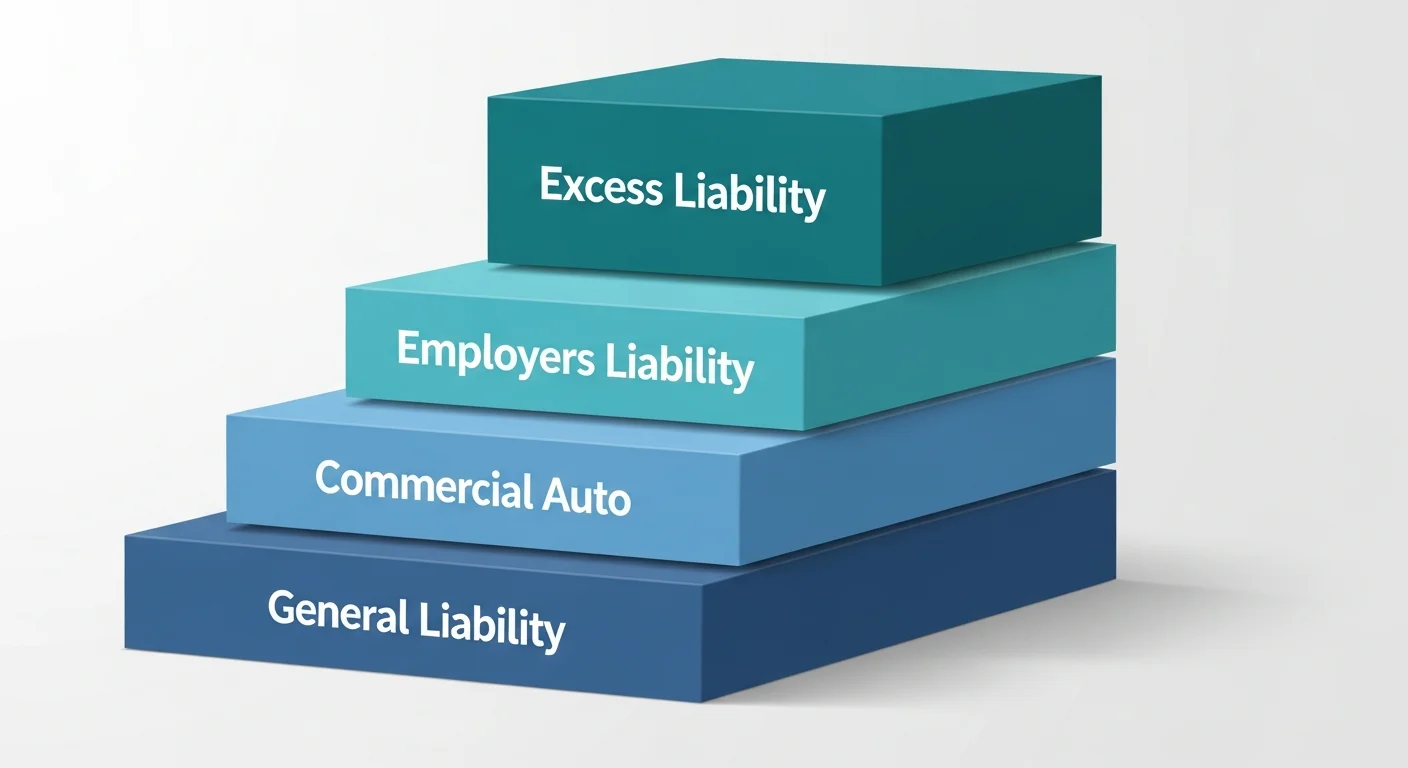
How Claims Get Paid
- A covered claim occurs. An event triggers a liability claim against your business, such as a bodily injury, property damage, or auto accident.
- Your primary policy responds first. Your underlying policy (general liability, commercial auto, etc.) pays the claim up to its per-occurrence limit.
- If the claim exceeds primary limits, the excess policy activates. Once the primary insurer confirms that its policy limit has been exhausted, the excess liability carrier begins paying the remainder of the claim, up to the excess policy limit.
- If the claim exceeds both layers, your business is responsible. Any amount above both the primary and excess limits becomes an out-of-pocket obligation for the business.
What Is an “Attachment Point”?
The “attachment point” is the dollar amount at which excess coverage begins. It typically matches the per-occurrence limit of the underlying policy. If your general liability policy has a $1 million limit, the excess policy attaches at $1 million. Some excess policies may have a different attachment point, so reviewing the specific terms is essential.
Why Primary Insurance Isn’t Always Enough: Real-World Claim Examples
It’s easy to assume a standard liability policy provides enough protection, but catastrophic events can exhaust those limits faster than you might think. Imagine a construction company’s crane collapses, damaging nearby properties and causing multiple serious injuries; the resulting claims could easily climb into the millions. Or consider a transportation business whose truck is involved in a multi-vehicle pile-up, leading to extensive lawsuits that far exceed the limits of their commercial auto insurance. In these worst-case scenarios, once the primary policy pays its maximum, your company is on the hook for the rest. This is precisely the gap excess liability insurance is designed to fill, providing a critical safety net to protect your business assets from devastating financial judgments.
Following Form vs. Self-Contained: What’s the Difference?
Most excess liability policies are “following form,” meaning they follow the same terms, conditions, and exclusions as the underlying policy. A following-form excess policy will not cover something that the primary policy excludes. Some excess policies are self-contained, with their own independent terms. Self-contained policies may offer broader or narrower coverage than the underlying policy depending on their specific language.
Excess liability coverage follows a clear payment hierarchy: the primary policy pays first, and the excess policy only activates after the primary limit is fully exhausted. Understanding this sequence is critical for proper risk management planning, because gaps between policies can leave a business exposed.
Excess Liability vs. Umbrella Insurance: Which Is Right for You?
These two terms are frequently used interchangeably, but they are not the same product. The distinction matters for your coverage strategy.
Umbrella insurance provides additional liability limits similar to excess liability, but with two key differences:
Comparing the Scope of Coverage
- Excess liability only covers claims that are already covered by the specific underlying policy it sits above. It does not add new coverage categories.
- Umbrella insurance can provide “drop-down” coverage for claims that may not be covered by any underlying policy, subject to a self-insured retention (SIR). This means umbrella policies can be broader in scope.
Checking the Underlying Policy Requirements
- Excess liability typically sits above a single underlying policy (e.g., excess over general liability only).
- Umbrella insurance usually covers multiple underlying policies simultaneously (general liability, auto liability, employers liability) under one umbrella.
What Is a Self-Insured Retention (SIR)?
- Excess liability generally has no self-insured retention. It activates once the underlying policy limit is exhausted.
- Umbrella insurance often includes an SIR (commonly $10,000 to $25,000) for claims where no underlying coverage applies.
Which One Should You Choose?
For businesses that need higher limits on a specific policy line, excess liability is often the straightforward solution. For businesses seeking broader protection across multiple policy types with the added benefit of drop-down coverage, umbrella insurance may be more appropriate. Many mid-size and large businesses carry both.
Don’t let a major claim bankrupt your business. Get an excess liability insurance quote from Insurance Underwriters.
What Does Excess Liability Insurance Cover?
Excess liability insurance does not create new coverage. It extends the coverage already provided by the underlying policy it is attached to. The specific covered claims depend entirely on the underlying policy.
Common underlying policies that excess liability may sit above include:
- Commercial general liability (CGL): Covers third-party bodily injury, property damage, personal injury, and advertising injury claims. An excess policy extends these limits for larger claims.
- Commercial auto liability: Covers bodily injury and property damage from fleet vehicle accidents. Commercial auto claims involving severe injuries or multiple vehicles can quickly exceed standard limits.
- Employers liability: Covers claims from employees for workplace injuries that fall outside workers’ compensation. High-severity workplace accidents can generate claims well beyond employers liability limits.

What Excess Liability Insurance Does NOT Cover
Because excess liability follows the terms of the underlying policy, it shares the same exclusions. Common exclusions include:
- Intentional acts or criminal conduct
- Contractual liability (unless assumed in an insured contract)
- Pollution liability (typically requires a separate environmental policy)
- Professional errors and omissions (covered under a separate professional liability policy)
- Employment practices claims (covered under separate EPLI policies)
- Workers’ compensation benefits (covered under the workers’ comp policy itself)
Who Needs Excess Liability Insurance?
Any business that faces the possibility of a liability claim exceeding its primary policy limits should consider excess liability coverage. However, certain businesses have a particularly strong need.
Are You in a High-Risk Industry?
- Construction: Workplace injuries, equipment accidents, and third-party property damage create frequent high-severity claims. Construction businesses face some of the highest average claim costs across all industries.
- Transportation and trucking: Fleet accidents involving commercial vehicles can result in multi-million-dollar judgments, particularly when serious injuries occur.
- Healthcare: Medical malpractice and patient injury claims regularly exceed $1 million per occurrence.
- Manufacturing: Product liability claims can generate massive settlements, especially if a defective product causes widespread harm.
- Hospitality: Hotels, restaurants, and entertainment venues face premises liability claims from guests and visitors that can escalate quickly.
Additional Industries with Significant Exposure
Beyond the most obvious high-stakes operations, several industries regularly face liability claims that can easily overwhelm standard insurance policies. If your business operates in one of these sectors, excess liability isn’t just a good idea—it’s a critical part of a sound risk management strategy.
- Healthcare: The potential for a single medical malpractice or patient injury claim to exceed $1 million is a constant reality for healthcare providers. From small clinics to large hospitals, this exposure makes excess liability a crucial safeguard against claims that could otherwise be financially crippling. It provides the necessary buffer to protect assets when patient care goes wrong.
- Manufacturing: Manufacturers live with the risk of product liability lawsuits. A single defective product that causes widespread harm can lead to massive, company-threatening settlements. Excess liability coverage is essential for absorbing the financial shock of large-scale claims and protecting the business from catastrophic loss.
- Hospitality: Businesses like hotels, restaurants, and event venues are always susceptible to premises liability claims from guests. A simple slip-and-fall can escalate into a costly lawsuit. Excess liability insurance provides an essential layer of protection for when these claims breach the limits of a primary general liability policy.
- Transportation and Trucking: A serious accident involving a commercial vehicle can easily result in a multi-million-dollar judgment, especially when multiple parties or severe injuries are involved. For any company with a fleet, excess liability is a must-have to cover the immense financial risk associated with being on the road.
- Construction: The construction field is well-known for high-cost claims stemming from workplace injuries, equipment accidents, and third-party property damage. Given the inherent dangers of the job site, businesses in the construction industry often require significant excess liability coverage to adequately protect against severe financial losses.
When Contracts Require Extra Insurance
Many contracts, especially in commercial real estate, construction, and government work, require businesses to carry minimum liability limits of $5 million or $10 million. Primary policies rarely offer limits that high, making excess liability insurance a practical necessity for contract compliance.
Protecting Your Business’s Assets
Companies with substantial revenue, real estate holdings, equipment, or intellectual property have more to lose in a lawsuit. Higher liability limits protect those assets from being seized or attached to satisfy a judgment.
Businesses in construction, healthcare, transportation, and manufacturing face the highest liability exposure and benefit most from excess liability coverage. Contract requirements frequently mandate higher limits that only excess or umbrella policies can provide.
Protecting Your Personal Assets and Lifestyle
While this guide focuses on commercial protection, the same principles apply to your personal life. A significant liability claim doesn’t distinguish between business and personal assets. A severe car accident or an injury on your property can lead to a lawsuit that targets your home, savings, investments, and future income. For high-net-worth individuals and families, standard homeowners and auto insurance policies often provide insufficient limits to cover a catastrophic event. Excess liability insurance exists to prevent that scenario by adding a critical layer of financial protection above your existing coverage, safeguarding the lifestyle you’ve worked hard to build.
Common Personal Liability Risks to Consider
Liability risks are not confined to your workplace; they are an inherent part of daily life. Any individual with significant assets faces the possibility of a claim exceeding their primary policy limits. Understanding where these risks come from is the first step toward building a comprehensive protection strategy. From hosting a party at your home to posting on social media or driving your car, common activities can unexpectedly lead to major financial exposure. A personal umbrella or excess liability policy is designed to respond when these everyday situations result in extraordinary claims, ensuring one unfortunate event doesn’t jeopardize your financial security.
At Home and Online
Your home is often your greatest asset, but it can also be your greatest source of liability. A guest slipping on a wet floor, a dog biting a neighbor, or a child getting injured in your swimming pool can all result in lawsuits that quickly surpass the limits of a standard homeowners policy. Your digital life carries risks, too. A negative online review or a social media post could lead to a defamation, libel, or slander lawsuit. These “personal injury” claims are often covered by umbrella policies, providing a crucial defense against risks that extend beyond physical property.
On the Road and Abroad
A serious auto accident is one of the most common causes of multi-million-dollar liability claims. If you are found at fault for an accident that causes severe injuries or fatalities, the resulting judgment can easily exhaust even the highest available auto insurance limits. This risk extends to any vehicles you operate, including boats, RVs, or rental cars while traveling. An incident abroad can be even more complex and costly. Excess liability coverage follows you, providing a safety net for accidents that happen far from home and protecting your assets from devastating legal and medical costs.
Simple Ways to Lower Your Personal Risk
While you can’t eliminate all risks, you can take simple, proactive steps to manage your personal liability exposure. Start by ensuring your primary home and auto policies have adequate limits. Implement safety measures on your property, such as securing pools with fences and maintaining your walkways. Be mindful of your digital footprint and what you post online. Most importantly, a comprehensive risk assessment is key. Understanding the mechanics of excess liability insurance helps clarify how the coverage applies, and an expert can help you align your coverage with your net worth. At Insurance Underwriters, we help clients build a unified strategy to protect both their business and personal assets.
How Much Excess Liability Coverage Do You Really Need?
Choosing the right limit is a critical business decision that balances cost with protection. While there is no universal formula, you can determine an appropriate amount by evaluating your company’s specific exposures.
Guidelines for Businesses
Determining the right amount of excess liability coverage isn’t about picking a number out of a hat; it’s a strategic calculation based on your specific risk profile. Start by looking at your industry. Businesses in high-risk sectors like construction, transportation, or healthcare often face multi-million dollar claims and should consider limits of $5 million or more. Next, review your contracts. Many client agreements and commercial leases mandate specific liability limits, often $5 million or $10 million, making excess coverage a requirement for doing business. Finally, consider your assets. If your company has significant real estate, equipment, or revenue, you need enough coverage to protect those assets from being seized in a lawsuit. A thorough risk assessment with your broker can help you quantify your exposure and select a limit that aligns with your balance sheet and operational risks.
Guidelines for Individuals and Families
Excess liability isn’t just for businesses. A personal umbrella or excess policy provides a critical secondary layer of protection for your personal assets. A common guideline is to secure coverage equal to your net worth, but it’s important to calculate that figure comprehensively. Tally up your home equity, savings, investment portfolios, and even the value of future earnings, as all can be at risk in a major lawsuit. Think about your personal exposure: Do you have a swimming pool, own a dog, or have teenage drivers? These factors increase your liability risk. A significant car accident or an injury on your property can easily result in a claim that exhausts the limits of your standard home or auto policies, making personal excess coverage a smart move for protecting your financial future.
How Much Does Excess Liability Insurance Cost?
Excess liability insurance is generally one of the most cost-effective ways to increase your liability protection. Because it only pays after primary limits are exhausted, the risk to the excess insurer is statistically lower, which translates to relatively affordable premiums.
What Can You Expect to Pay?
While every business is different, the following ranges provide a general benchmark:
- $1 million excess policy: Typically $500 to $3,000 per year for low-to-moderate risk businesses
- $5 million excess policy: Typically $2,000 to $10,000 per year depending on industry and claims history
- $10 million excess policy: Typically $5,000 to $25,000+ per year for higher-risk operations
These are rough estimates. Actual premiums depend heavily on industry, claims history, revenue, and the limits of underlying policies. A small business with a clean claims history in a low-risk industry will pay significantly less than a large construction firm with prior losses.
Breaking Down the Cost Per Million of Coverage
A useful metric for comparing excess liability quotes is the cost per million dollars of coverage. Rates typically decrease as the limit increases, because the probability of a claim reaching higher layers diminishes. The first $1 million of excess coverage above a primary limit will always cost more than the fifth or tenth million.
What Factors Influence Your Premium?
Insurance carriers evaluate several variables when pricing an excess liability policy. Understanding these factors helps you anticipate costs and identify opportunities to improve your rate.
How Your Industry Impacts Your Rate
Your industry is the single largest factor in premium calculation. Construction, transportation, and healthcare businesses pay significantly higher rates than professional services or retail operations due to the frequency and severity of claims in those sectors.
The Role of Your Claims History
Your loss history over the past 3 to 5 years directly impacts pricing. Businesses with frequent claims or high-severity losses will face higher premiums or may struggle to find coverage at standard rates.
Why Revenue and Payroll Matter
Higher revenue and payroll generally indicate greater exposure, which translates to higher premiums. A $50 million revenue construction company will pay more than a $5 million revenue firm in the same industry.
How Your Base Policy Limits Affect Cost
The limits of your primary policies affect the attachment point and, therefore, the risk assumed by the excess carrier. Higher underlying limits generally result in lower excess premiums because the excess carrier is further from the first dollar of risk.
Does Your Location Change Your Premium?
Businesses operating in states with higher litigation rates, larger jury awards, or more plaintiff-friendly legal environments will pay more. Florida, California, New York, and Texas tend to have higher rates than less litigious states.
Good Risk Management Can Lower Your Costs
Carriers reward businesses that demonstrate strong safety programs, employee training, contractual risk transfer, and proactive risk management. Formal safety protocols, regular audits, and loss-control measures can result in premium credits.
How to Choose the Right Excess Liability Policy
Selecting the right excess liability coverage requires more than just picking a limit. Several factors should guide your decision.
1. Assess Your Total Exposure
Work with your insurance advisor to estimate the maximum potential cost of a worst-case liability claim for your business. Consider industry benchmarks, historical jury awards in your jurisdiction, and the specific risks inherent to your operations. Your excess limit should be high enough to cover a realistic worst-case scenario.
2. Review Contract Requirements
If your business regularly enters contracts that specify minimum liability limits, ensure your combined primary and excess limits meet or exceed those requirements. Failing to maintain required limits can result in breach of contract claims.
3. Match the Underlying Policy
Ensure your excess policy specifically lists the underlying policies it covers and that the attachment points align with your primary policy limits. Gaps between the primary limit and the excess attachment point create uninsured exposure.
4. Understand the Policy Form
Confirm whether the excess policy is following form or self-contained. If following form, verify that the terms of the underlying policy are acceptable for the excess layer. If self-contained, carefully review the independent terms, conditions, and exclusions.
5. Evaluate the Carrier
Excess liability claims tend to involve large dollar amounts, so the financial strength of the carrier matters. Look for carriers with strong A.M. Best ratings (A- or better) and a track record of paying large claims without dispute.
6. Work With a Specialist
Excess liability placements can involve complex layering, especially for businesses that need $10 million, $25 million, or more in total limits. Working with an experienced insurance advisor ensures your program is structured correctly with no gaps between layers.
Insurance Underwriters specializes in designing layered liability programs for businesses across Florida and nationwide. Our team evaluates your total risk profile and builds a coverage structure that eliminates gaps while keeping costs efficient.
Frequently Asked Questions
How is excess liability different from umbrella insurance?
Excess liability provides additional limits above a specific underlying policy and follows its terms. Umbrella insurance typically covers multiple underlying policies and can provide drop-down coverage for claims not covered by any underlying policy, subject to a self-insured retention. Both increase your total liability limits, but umbrella policies offer broader scope.
How much excess liability coverage do I need?
The right amount depends on your industry, asset base, contractual requirements, and risk tolerance. As a starting point, consider the maximum realistic judgment your business could face. Many mid-size businesses carry $5 million to $10 million in excess coverage, while larger operations may need $25 million or more.
Does excess liability insurance cover defense costs?
It depends on the underlying policy. If the underlying policy includes defense costs within the limit (eroding the limit), the excess policy may be triggered sooner. If defense costs are outside the limit (supplementary), they do not reduce the primary limit or trigger the excess policy. Review both policies to understand how defense costs are handled.
Can I buy excess liability insurance without an underlying policy?
No. Excess liability insurance requires a qualifying underlying policy to be in place. The excess policy sits above the underlying policy and only responds after that policy’s limits are exhausted. Without an underlying policy, there is nothing for the excess coverage to attach to.
Is excess liability insurance tax deductible?
For businesses, excess liability insurance premiums are generally deductible as an ordinary and necessary business expense. Consult with your tax advisor to confirm the deductibility based on your specific situation and tax jurisdiction.
How long does it take to get excess liability coverage?
For straightforward risks, coverage can often be bound within a few business days. Complex risks or large limits may require underwriting review from multiple carriers and could take 2 to 4 weeks. Having your current policy information, loss runs, and financial data ready accelerates the process.
Get the Right Excess Liability Coverage for Your Business
Standard liability limits were not designed for catastrophic claims. When a judgment exceeds your primary policy, the financial consequences can threaten your business’s survival. Excess liability insurance provides a cost-effective safety net that protects your assets, your revenue, and your future.
Whether you need $1 million in additional coverage or a multi-layered program exceeding $25 million, the right structure depends on your industry, your risk profile, and your contractual obligations. Getting this right requires an advisor who understands complex liability placements.
Contact Insurance Underwriters today to discuss your excess liability insurance needs. Our team will evaluate your current coverage, identify gaps, and build a protection strategy tailored to your business.
Key Takeaways
- It’s a financial safety net for worst-case scenarios: Excess liability insurance adds higher coverage limits on top of your existing liability policies. It only activates after your primary policy’s limit is completely used, protecting your business assets from a financially devastating claim.
- It’s essential for high-risk industries and contract compliance: If your business is in a high-exposure field like construction or transportation, or if clients require you to carry multi-million dollar limits, excess liability is often a necessity. Standard policies alone typically won’t meet these demands.
- Your coverage amount should be a calculated decision: Choosing the right limit involves a careful review of your total assets, potential claim severity, and contractual obligations. This strategic approach ensures your coverage aligns with your actual financial exposure, leaving no critical gaps.
Related Articles
- Excess Liability Insurance Guide – Insurance Underwriters
- Umbrella Insurance: What It Is & Why You Need It
- CGL Insurance: The Complete Policy Guide
- Commercial Auto Insurance: What It Covers, Who Needs It, and How Much It Costs – Insurance Underwriters
- Professional Liability Insurance: What It Covers and Why Your Business Needs It – Insurance Underwriters
Comments
Comments are closed.