
What Is Umbrella Insurance and Why You Need It
You have car and homeowners insurance, so you probably feel pretty covered. But what happens when a serious accident or lawsuit goes beyond your policy limits? Those massive costs don’t just disappear—they can come directly from your personal savings, investments, and even future earnings. This is exactly where umbrella insurance steps in. It’s an extra layer of protection that kicks in right when your other policies tap out, acting as a crucial safety net for everything you’ve worked for.
Get your free umbrella insurance quote or call (305) 900-2823 to speak with an advisor at Insurance Underwriters today.
A personal umbrella policy adds $1 million or more in additional liability protection on top of your existing coverage, and it typically costs less than $1 per day. For anyone with assets worth protecting, or anyone who could face a lawsuit exceeding standard policy limits, umbrella insurance is one of the most cost-effective forms of financial protection available.
This guide explains what umbrella insurance is, how it works, what it covers (and what it does not), how much it costs, and how to determine whether you need it.
What Is Umbrella Insurance?
Umbrella insurance is a type of personal liability insurance that provides extra coverage beyond the limits of your underlying policies, including homeowners insurance, auto insurance, renters insurance, and watercraft insurance. It is called an “umbrella” because it extends broad protection over multiple existing policies under a single supplemental layer.
When a covered liability claim exceeds the limit of your primary policy, the umbrella policy kicks in to pay the difference, up to its own limit. Most umbrella policies start at $1 million in coverage and are available in increments up to $5 million or $10 million.
For example, if you carry $300,000 in liability coverage on your auto policy and are found liable for an accident resulting in a $1.2 million judgment, your auto insurance pays the first $300,000. Without umbrella insurance, you owe the remaining $900,000 out of pocket. With a $1 million umbrella policy, that gap is covered.
Umbrella insurance is classified as excess liability coverage. Unlike your primary policies, which cover specific assets or vehicles, an umbrella policy sits on top of everything and provides a unified additional layer of defense.
What an Umbrella Policy Actually Includes
- Excess liability coverage: Pays claims that exceed the limits of your underlying policies
- Broader protection: Covers certain liability claims that standard policies may exclude, such as libel, slander, defamation, and false arrest
- Drop-down coverage: Can act as primary coverage for claims not addressed by underlying policies, subject to a self-insured retention (SIR) or deductible
- Worldwide coverage: Most policies provide protection regardless of where the incident occurs
- Household coverage: Typically extends to all members of the policyholder’s household
How Does Umbrella Insurance Work?
Umbrella insurance functions as a second layer of protection. It does not replace your existing policies; it supplements them.
Here is how the process works in practice:
- An incident occurs where you are found liable for bodily injury, property damage, or personal injury to another person.
- Your primary policy responds first. Your auto, homeowners, or other relevant policy pays up to its liability limit.
- If the claim exceeds your primary limit, the umbrella policy activates and covers the remaining amount, up to its own limit.
- Legal defense costs are typically covered in addition to the policy limit, meaning they do not reduce your available coverage.
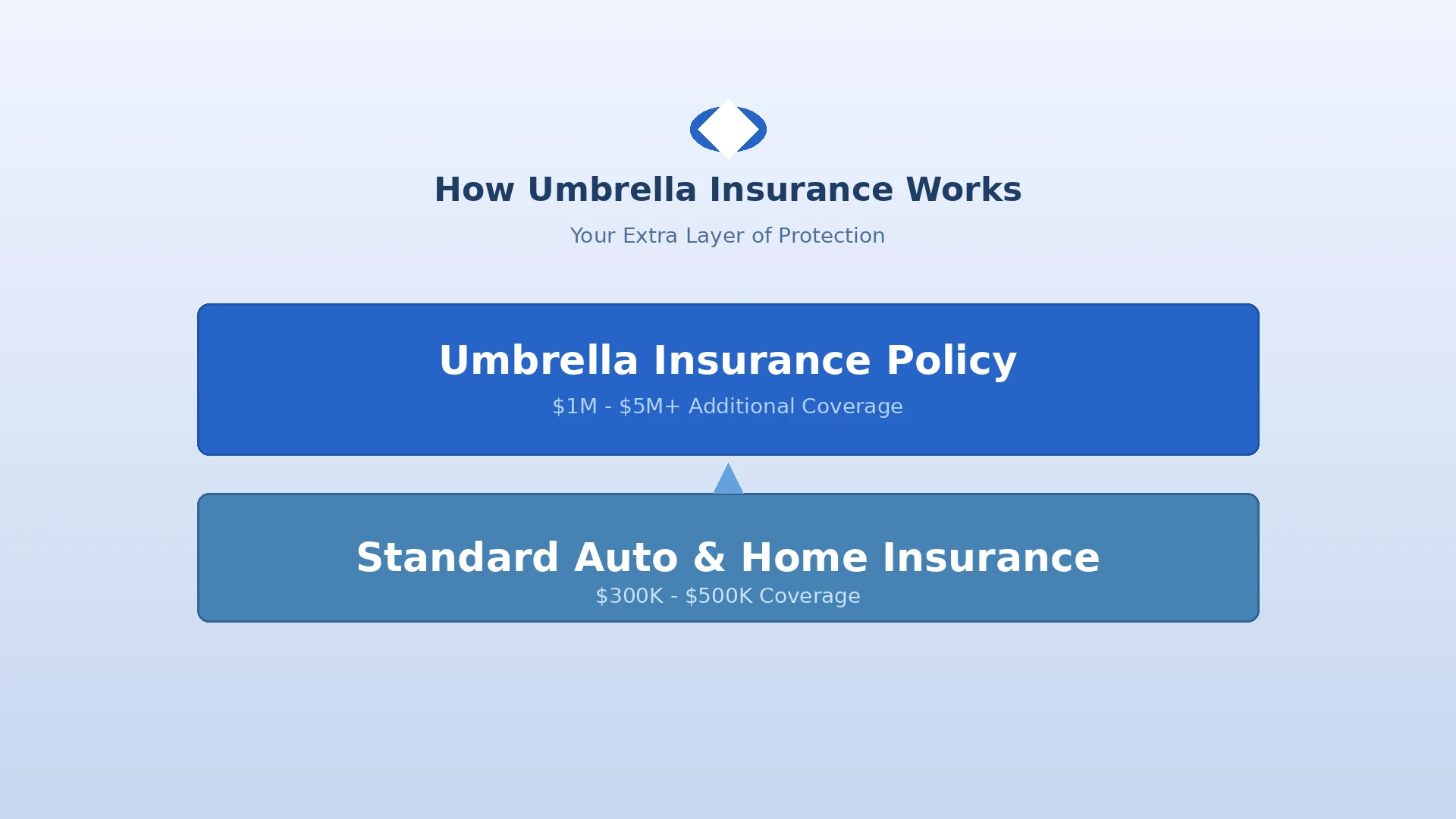
An Umbrella Policy in Action
Suppose you host a gathering at your home and a guest slips on your patio, suffering a severe spinal injury. Medical expenses and lost wages total $1.5 million, and the guest sues. Your homeowners policy carries $500,000 in personal liability coverage. Here is how the claim breaks down:
| Layer | Amount Paid |
|---|---|
| Homeowners liability | $500,000 |
| Umbrella policy ($2 million) | $1,000,000 |
| Your out-of-pocket cost | $0 |
Without the umbrella policy, you would owe $1 million personally, potentially forcing you to liquidate assets, drain retirement savings, or face wage garnishment.
What Is “Drop-Down” Coverage?
One of the most valuable features of umbrella insurance is drop-down coverage. This means the umbrella can provide primary coverage for certain claims that your underlying policies do not cover at all. Examples include:
- Defamation or libel: If you are sued for something you said or wrote that damaged someone’s reputation
- False arrest or wrongful detention: If you are involved in a situation where someone claims they were unlawfully detained
- Invasion of privacy: Claims related to violating another person’s privacy
In these cases, you typically pay a self-insured retention (SIR), usually between $250 and $10,000, and the umbrella policy covers the rest.
What Does Umbrella Insurance Cover?
Umbrella insurance provides broad liability protection. While policy details vary by insurer, most umbrella policies cover:
Bodily Injury to Others
This is the most common type of umbrella claim. If someone is physically injured due to your negligence, whether in a car accident, at your home, or at another location, umbrella insurance covers medical bills, rehabilitation costs, lost wages, and pain and suffering damages beyond your primary policy limits.
According to industry data, approximately 78% of personal umbrella claims originate from auto accidents. A single serious car crash can generate medical and legal costs well into seven figures.
Damage to Someone’s Property
If you accidentally damage someone else’s property and the costs exceed your primary coverage, your umbrella policy covers the excess. This can include situations like causing a multi-vehicle accident, accidentally starting a fire that spreads to a neighbor’s home, or damage caused by your watercraft.
Personal Injury (Like Slander or Libel)
Beyond physical injuries, umbrella policies cover personal injury claims, which include:
- Libel and slander: Written or spoken statements that damage someone’s reputation
- Defamation: False statements presented as facts that cause harm
- Wrongful eviction: If you are a landlord and a tenant claims unlawful eviction
- Malicious prosecution or false arrest: Claims arising from legal actions taken against another person
These types of claims are increasingly common in the age of social media, where a single post can lead to a defamation lawsuit.
Your Legal Defense Costs
Umbrella policies typically cover attorney fees, court costs, and other legal expenses associated with defending covered claims. In many cases, defense costs are paid in addition to the policy limit, so hiring an attorney does not reduce the coverage available to pay a judgment.
Liability as a Landlord
If you own rental properties, your umbrella policy generally extends to cover liability claims arising from those properties. This is particularly important for landlords who face exposure to tenant injury claims, premises liability, and habitability disputes.
Unique Scenarios and Coverage Gaps
An umbrella policy offers an incredible amount of protection, but it’s not limitless. Understanding a few specific scenarios and potential gaps in coverage is the key to making sure your financial safety net is as strong as you think it is. Some of the most valuable features of an umbrella policy come into play in situations you might not expect, while common assumptions about coverage can leave you exposed. That’s why working with an advisor is so important—they can help you identify risks you might not see on your own and build a truly comprehensive plan.
Liability from rental activities
If you own rental properties, your umbrella policy is a critical extension of your landlord insurance, providing extra protection against tenant injury claims and habitability disputes. But what about the sharing economy? If you occasionally rent out your home on a platform like Airbnb or your car through a service like Turo, you’re creating new liability exposures. While these platforms offer some insurance, a major lawsuit could easily exceed their limits. An umbrella policy can extend over your primary homeowners or auto policy to provide the high-limit liability protection you need for these modern rental activities, giving you peace of mind.
Assumed contractual liability
Have you ever signed a waiver before trying a new activity, like at a trampoline park or even a local fun run? By signing, you’re often agreeing to take on the risk yourself. This is called “assumed contractual liability,” and it’s a perfect example of where an umbrella policy’s drop-down coverage can be invaluable. Your standard policies likely won’t cover a claim in this situation, but your umbrella might. This is a key feature, as the umbrella can provide primary coverage for certain claims your other policies don’t cover at all. It’s a small detail that protects you in those everyday moments you might not think twice about.
Understanding “Worldwide Coverage” Limitations
Many umbrella policies advertise “worldwide coverage,” which sounds like you’re protected no matter where an incident occurs. However, the fine print often contains a critical limitation: most policies only respond to lawsuits brought within the United States or Canada. This means if you are involved in an at-fault accident while traveling abroad and get sued in a foreign court, your policy may not cover your legal defense or a judgment. For executives who travel for business or anyone with a global lifestyle, this is a significant gap. It’s essential to review your policy’s “coverage territory” clause with an advisor. The team at Insurance Underwriters can help you find a policy that aligns with your life, ensuring your protection doesn’t have geographic blind spots.
What Isn’t Covered by Umbrella Insurance?
Understanding exclusions is just as important as understanding coverage. Umbrella insurance does not cover:
- Your own injuries or property damage: Umbrella policies are liability-only. They protect you from claims by others, not from damage to your own property or injuries to yourself.
- Intentional acts: If you deliberately cause harm to another person or their property, no umbrella policy will cover the resulting claim.
- Business or professional liability: Personal umbrella policies do not cover claims arising from business activities. Business owners need commercial umbrella insurance or a separate commercial general liability policy.
- Contractual liability: Obligations you voluntarily assume under a contract are generally excluded.
- Workers’ compensation claims: These are handled by a separate workers’ compensation policy.
- Damage caused by certain breeds of dogs: Some insurers exclude specific breeds; others may cover them with restrictions.
- Damage from certain watercraft or vehicles: High-performance boats or vehicles may require separate endorsements. Boat and jet ski owners in particular benefit from umbrella policies. Learn more in our watercraft insurance guide.
If you have questions about specific exclusions, speak with an insurance advisor who can review your individual risk profile and recommend appropriate coverage.
How Much Does Umbrella Insurance Cost?
Umbrella insurance is one of the most affordable forms of coverage relative to the protection it provides. Here are typical costs:
| Coverage Amount | Annual Premium (Approximate) |
|---|---|
| $1 million | $150 to $350 |
| $2 million | $225 to $450 |
| $3 million | $300 to $550 |
| $5 million | $450 to $750 |
Several factors influence the exact cost of your umbrella policy:
- Number of properties you own: More properties mean more liability exposure
- Number of vehicles and drivers: Households with teen drivers or multiple vehicles typically pay more
- Driving record: A history of at-fault accidents or traffic violations raises premiums
- Owned watercraft or recreational vehicles: Boats, jet skis, and ATVs add liability exposure
- Rental properties: Landlords face higher premiums due to additional tenant-related risk
- Claim history: Previous umbrella or liability claims may increase costs
- Location: Premiums vary by state and metropolitan area
Most insurers require minimum underlying liability limits before issuing an umbrella policy. Common requirements include:
- Auto insurance: $250,000/$500,000 bodily injury liability (or $300,000 combined single limit)
- Homeowners insurance: $300,000 to $500,000 in personal liability coverage
Meeting these requirements may slightly increase your auto and homeowners premiums, but the total cost of the umbrella plus any underlying increases is typically modest.
Average Annual Premiums
One of the most appealing aspects of umbrella insurance is its affordability, especially when you consider the amount of protection it offers. For a standard $1 million policy, most people can expect to pay between $150 and $350 per year. That breaks down to less than a dollar a day for an extra million dollars in financial security. As you add more coverage, the cost per million typically decreases. For instance, a $5 million policy might range from $450 to $750 annually. Because your premium depends on factors like your driving history and the number of properties you own, the best way to understand your cost is to get a personalized quote that reflects your specific risk profile.
How Bundling Can Lead to Savings
Before an insurer will issue an umbrella policy, they need to know you have a solid foundation of primary coverage. This typically means having at least $250,000/$500,000 in bodily injury liability on your auto policy and $300,000 or more in liability on your homeowners insurance. A smart way to meet these requirements and lower your overall cost is by bundling your policies with a single carrier. Insurers often provide discounts of 10% to 25% when you combine your home, auto, and umbrella coverage. This also simplifies your insurance management with one point of contact for billing and claims. As an independent brokerage, Insurance Underwriters can compare options from multiple top-rated carriers to find the bundle that delivers the best protection and value for you.
Do You Need an Umbrella Insurance Policy?
The short answer: anyone whose assets and future income exceed their existing liability limits. But certain individuals and families face elevated risk and benefit most from umbrella coverage.
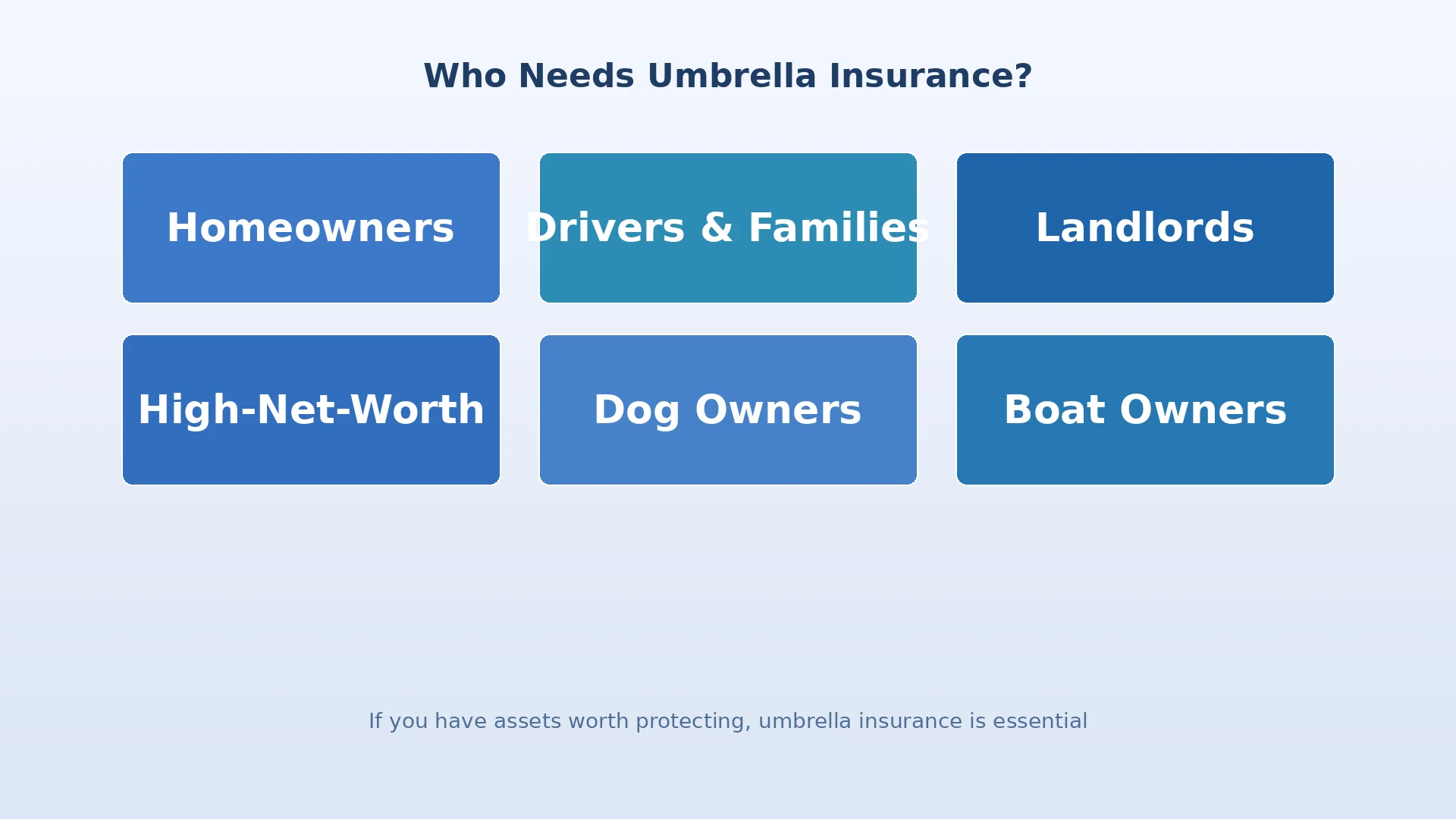
It’s Not Just for the Wealthy
It’s a common myth that umbrella insurance is only for the ultra-wealthy, but you don’t need a mansion to face a million-dollar lawsuit. Everyday life comes with risks that can easily exceed the liability limits on your standard home or auto policies. If you own a home, have a teenage driver, host guests, own a dog or a swimming pool, or are even active on social media, you have significant liability exposure. A serious car accident, a guest getting injured on your property, or a defamation claim from an online comment can all lead to financially devastating lawsuits. For what often amounts to less than a dollar a day, a personal umbrella policy provides an extra million dollars or more in financial protection, safeguarding not just your current assets but your future income as well. It’s one of the most cost-effective ways for anyone to secure their financial future.
You’re a Homeowner
Owning a home automatically increases your liability exposure. Swimming pools, trampolines, tree houses, elevated decks, and even unfenced yards can all lead to injury claims from visitors, neighbors, or delivery workers. If someone is injured on your property and the claim exceeds your homeowners liability limit, an umbrella policy covers the difference.
You Have a Teen Driver
Auto accidents are the single largest source of personal umbrella claims. If your household includes teen or young adult drivers, who statistically have higher accident rates, umbrella insurance becomes essential. A single at-fault accident causing severe injuries can easily generate a seven-figure judgment.
You’re a Landlord
Rental property owners face liability from tenant injuries, habitability claims, wrongful eviction lawsuits, and other premises-related incidents. Umbrella insurance extends coverage across all your rental properties.
You Have Significant Assets
If you own significant assets, including investment portfolios, real estate, business equity, or high-value personal property such as jewelry, fine art, or watercraft, you are a larger target for lawsuits. An umbrella policy protects those assets from being seized to satisfy a judgment.
You Own a Dog
Dog bite claims account for over one-third of all homeowners insurance liability payouts. The average cost of a dog bite claim is over $50,000, and severe cases can exceed $1 million.
You Own a Boat or Watercraft
Boating accidents can result in serious injuries and substantial property damage. If you own a boat, jet ski, or other watercraft, umbrella insurance provides an additional layer of liability protection beyond your marine policy.
You Serve on a Board
Serving on a nonprofit board, coaching a youth sports team, or volunteering in other capacities can expose you to personal liability claims that umbrella insurance may cover under its personal injury provisions.
You’re Active on Social Media
In today’s digital environment, a social media post, review, or comment can lead to a defamation or libel lawsuit. Umbrella insurance provides drop-down coverage for these types of claims.
Ready to protect your assets? Request a personalized umbrella insurance quote from Insurance Underwriters, or call us at (305) 900-2823 for a no-obligation consultation.
You’re a Retiree Protecting Your Savings
Retirement should be about enjoying your hard-earned savings, not worrying about a lawsuit wiping them out. While your lifestyle may have changed, your liability risk has not disappeared. A guest could slip at your home, or a minor car accident could lead to a major legal claim. Without enough coverage, a judgment could target your retirement accounts, investments, and property. An umbrella policy is an affordable way to protect your savings from these exact scenarios. It provides an extra million dollars or more in liability protection, creating a financial firewall around the nest egg you’ve worked so hard to build and ensuring legal defense costs don’t drain your funds.
How Much Umbrella Coverage Should You Get?
Start With Your Net Worth
Start with your total assets: home equity, savings, investments, retirement accounts, vehicles, and valuable personal property. Your umbrella coverage should at least equal your net worth.
Factoring in Legally Protected Assets
It’s a common misconception that certain assets, like your 401(k) or primary residence, are completely untouchable in a lawsuit. While laws like ERISA and state homestead exemptions offer a shield, this protection isn’t absolute and can be challenged in court. Relying on it alone is a risky strategy that could force you into a long and expensive legal fight to defend what’s yours. Even if you ultimately win, the attorney fees can be staggering. An umbrella policy helps cover your legal defense costs, often in addition to the liability limit. The goal is to have enough coverage to settle a claim efficiently, preserving your wealth instead of depleting it in a fight over which assets a court can seize.
Account for Future Earnings
A court judgment can garnish your future wages for years. If you earn a strong income, consider adding coverage to protect those future earnings as well.
Assess Your Personal Risks
Consider how many properties you own, whether you have a pool or trampoline, the number and ages of drivers in your household, pet ownership, watercraft, and your social or community activities. Higher risk means you should carry more coverage.
General Coverage Recommendations
| Net Worth | Recommended Coverage |
|---|---|
| Under $500,000 | $1 million |
| $500,000 to $1 million | $1 to $2 million |
| $1 million to $3 million | $2 to $3 million |
| Over $3 million | $3 to $5 million+ |
Since umbrella insurance is sold in $1 million increments and additional millions cost relatively little ($75 to $150 per year per additional million), it usually makes sense to buy slightly more coverage than you think you need.
High-Limit Policies for High-Net-Worth Individuals
For individuals with substantial assets, the general recommendations are merely a starting point. If you own significant assets—including investment portfolios, real estate, business equity, or high-value personal property like fine art or watercraft—you are a more visible target for lawsuits. Standard umbrella policies often go up to $5 million, but high-limit policies can extend to $10 million or more. This level of coverage is not just about matching your net worth; it is about creating a strategic defense to protect those assets from being seized to satisfy a judgment. It is a cost-effective way to ensure a single lawsuit does not derail your financial security.
Umbrella vs. Excess Liability Insurance: What’s the Difference?
These terms are sometimes used interchangeably, but they are not the same:
| Feature | Umbrella Insurance | Excess Liability Insurance |
|---|---|---|
| Coverage scope | Broader; can cover claims not in underlying policies | Narrower; only extends limits of underlying coverage |
| Drop-down coverage | Yes; can act as primary for uncovered claims | No; strictly follows underlying policy terms |
| Policy form | Its own separate terms and conditions | Mirrors the underlying policy (follow-form) |
| Best for | Individuals and families needing broad protection | Businesses seeking higher limits on specific policies |
For most individuals and families, a true umbrella policy is the better choice because of its broader coverage and drop-down provisions.
### The Rise of “Form-Following” Policies
It’s a common point of confusion, but many policies marketed as “umbrella” insurance are actually something else: form-following excess liability policies. These policies simply extend the dollar limits of your existing home or auto insurance. They “follow the form” of the underlying policy, meaning they only cover what’s already covered—just for a higher amount. If a specific risk, like a libel claim from a social media post, is excluded from your homeowners policy, this type of excess liability insurance won’t cover it either. This creates a dangerous gap in protection, as it gives you a false sense of security without actually broadening the scope of what you’re protected against.
### Why a “True” Umbrella Policy Offers Broader Protection
A true umbrella policy is designed to do more than just add money on top of your existing plans; it acts as a safety net to fill coverage gaps. It provides its own broader terms and can cover claims your primary policies don’t, such as personal injury (like slander or libel), false arrest, and wrongful eviction. This is where “drop-down” coverage becomes so valuable. If a claim isn’t covered by your home or auto policy, the umbrella can “drop down” to become your primary insurance for that specific incident, usually after you pay a small deductible. Furthermore, it covers legal defense costs, often in addition to the policy limit, ensuring your legal bills don’t deplete the funds needed to pay a judgment. For anyone seeking comprehensive financial protection, this broader coverage is essential.
How to Buy an Umbrella Insurance Policy
- Review your current coverage: Check your auto, homeowners, and any other liability policy limits to ensure they meet the minimums required by umbrella insurers.
- Assess your risk profile: Consider your assets, income, properties, vehicles, and lifestyle factors.
- Talk to an insurance advisor: An experienced advisor can help you determine the right coverage amount and find a policy that fits your needs and budget.
- Bundle when possible: Many insurers offer discounts when you purchase umbrella coverage alongside your auto and homeowners policies.
Insurance Underwriters works with multiple carriers to find the right umbrella policy for your specific situation. Whether you need personal umbrella coverage, commercial umbrella insurance, or a combination of both, our team evaluates your total risk exposure and recommends a tailored solution.
Frequently Asked Questions
Is umbrella insurance worth it?
Yes. For a cost of roughly $150 to $350 per year, you get $1 million in additional liability protection. Considering that a single serious lawsuit can exceed your standard policy limits by hundreds of thousands or even millions of dollars, umbrella insurance delivers significant value relative to its cost.
Do I need umbrella insurance if I do not have many assets?
Even if your current assets are modest, a lawsuit judgment can target your future earnings for years. Umbrella insurance protects not just what you own today, but what you will earn in the future.
Does umbrella insurance cover my business?
A personal umbrella policy does not cover business-related claims. If you are a business owner, you need a commercial liability policy or commercial umbrella insurance. Insurance Underwriters offers both personal and commercial coverage solutions.
Can I get umbrella insurance without owning a home?
Yes. Renters can purchase umbrella insurance. You will need an underlying renters insurance policy with sufficient liability limits, and most insurers also require auto insurance.
How does umbrella insurance apply to rental properties I own?
Personal umbrella policies generally extend to residential rental properties you own, provided you have the required underlying landlord insurance policy in place. Talk to your advisor to ensure your rental properties are properly scheduled on the policy.
Does umbrella insurance cover dog bites?
In most cases, yes. Umbrella insurance covers dog bite claims that exceed your homeowners liability limits. However, some insurers exclude certain breeds or impose restrictions. Discuss your specific situation with your insurance advisor.
Potential Downsides and Carrier Requirements
While umbrella insurance is a powerful tool, it’s not a standalone product you can buy off the shelf. Carriers have specific requirements you’ll need to meet before they’ll issue a policy, which can sometimes feel like a downside if you’re not prepared. Understanding these prerequisites ahead of time makes the process much smoother.
The need to increase underlying policy limits
Before an insurance company will offer you a $1 million umbrella, they want to see that you already have a solid foundation of coverage. Most insurers require you to carry minimum liability limits on your underlying policies. Common requirements include auto insurance with at least $250,000 per person and $500,000 per accident for bodily injury, and homeowners insurance with at least $300,000 to $500,000 in personal liability. If your current limits are lower, you’ll need to increase them, which will likely raise your auto and home premiums. It’s an added cost, but it’s a necessary step to qualify for this critical extra layer of protection.
Mandatory bundling with some insurers
Many insurance carriers will only sell you an umbrella policy if they also insure your home and vehicles. This practice, known as bundling, can be a great way to get a discount and simplify your insurance management with a single point of contact. However, it can also be a drawback if you’re happy with your current auto or home insurer and don’t want to switch. This is where working with an independent broker can be a huge advantage. They can find carriers that don’t require bundling or help you determine if switching to a new bundled package is the most cost-effective move for you.
Why You Should Request the Full Policy Document
An insurance quote or a marketing brochure gives you the highlights, but the full policy document tells the complete story. It’s essential to request and review this document because the exclusions—what the policy *doesn’t* cover—are just as important as the coverages. For example, a standard personal umbrella policy won’t cover liabilities related to your business, intentional acts, or damage to your own property. It might also have specific exclusions for things like certain dog breeds or high-performance watercraft. Reading the fine print ensures you have a clear picture of your protection and can identify any potential gaps you need to address with a separate policy or endorsement.
Checking for State and Carrier Availability
Not every insurance carrier offers umbrella policies in every state. Some national insurers may pause writing new policies in certain areas, such as coastal regions prone to hurricanes like Florida or Louisiana, due to heightened risk. This can make finding coverage feel challenging, but it’s rarely impossible. This is another area where local expertise becomes invaluable. An independent broker who is deeply familiar with the regional market can save you a lot of time and frustration. They know which carriers are actively writing policies in your state and can quickly connect you with the right options for your specific needs, navigating any state-specific regulations or availability issues on your behalf.
The Role of a Broker in Strategic Risk Planning
Buying an umbrella policy shouldn’t feel like a simple transaction; it should be part of a larger conversation about your financial security. This is where a skilled insurance broker truly shines. Instead of just selling you a policy, an experienced advisor acts as a strategic partner. They take the time to understand your complete financial picture—your assets, income, lifestyle, and future goals. From there, they help you determine the appropriate coverage amount and structure a plan that fits your budget. At Insurance Underwriters, we see our role as helping you build a comprehensive risk management strategy, ensuring your umbrella policy works seamlessly with your other coverage to provide total protection.
Is Umbrella Insurance a Smart Move for You?
Life is unpredictable, and even the most careful individuals can face unexpected lawsuits and liability claims. Umbrella insurance provides a critical safety net, protecting your home, savings, investments, and future earnings from a single event that could otherwise cause lasting financial damage.
At Insurance Underwriters, we help individuals and families across the United States build comprehensive protection strategies that include umbrella coverage tailored to their specific needs and risk profiles.
Get a liability umbrella quote today, or call us at 305-900-2823 to discuss your coverage options with one of our experienced advisors.
Looking for coverage for your personal valuables? Read our comprehensive guide to jewelry insurance guide to understand your options for protecting engagement rings, watches, and collections.
Key Takeaways
- It provides an extra layer of liability protection: An umbrella policy adds $1 million or more in coverage on top of your existing home and auto insurance, activating after your primary policy limits have been met.
- Coverage extends beyond physical accidents: A true umbrella policy offers broader protection than standard insurance, covering personal injury claims like libel, slander, and false arrest that your other policies often exclude.
- It’s an affordable way to protect your future: For a relatively low annual cost, umbrella insurance safeguards your current assets and future income from a financially devastating lawsuit, making it a wise choice for anyone with a financial future to protect.
Related Articles
- Umbrella Insurance: What It Is & Why You Need It
- Excess Liability Insurance Guide – Insurance Underwriters
- Commercial Umbrella Insurance – Insurance Underwriters
- Homeowners Insurance California: The Ultimate Guide
- General Liability Insurance: What It Covers, Costs, and Why Your Business Needs It – Insurance Underwriters
Comments
Comments are closed.