
Renters Insurance Florida: A Strategic Guide
Many tenants mistakenly believe their landlord’s insurance policy protects their belongings. It doesn’t. That policy only covers the building, leaving your furniture, electronics, and personal items completely exposed to risks like hurricanes, theft, or flooding. In Florida, that’s a huge gamble you can’t afford to take. For a surprisingly low cost, renters insurance Florida provides a critical financial safety net. It steps in to cover the cost of replacing everything you own and protects you from liability claims. Before you assume you’re covered, let’s look at why this affordable coverage is essential for every Florida renter.
Get a free renters insurance quote from Insurance Underwriters today and protect everything you own for less than the cost of a streaming subscription.
Renters insurance in Florida is a type of property insurance policy, formally known as an HO-4 policy, designed specifically for people who rent their living space rather than own it. Unlike homeowners insurance in Florida, which covers the physical structure of the building, renters insurance protects what belongs to you inside the property: your furniture, electronics, clothing, and other personal possessions. It also provides liability coverage if someone is injured in your rental unit and pays for temporary living expenses if your home becomes uninhabitable after a covered event.
What Does Florida Renters Insurance Actually Cover?
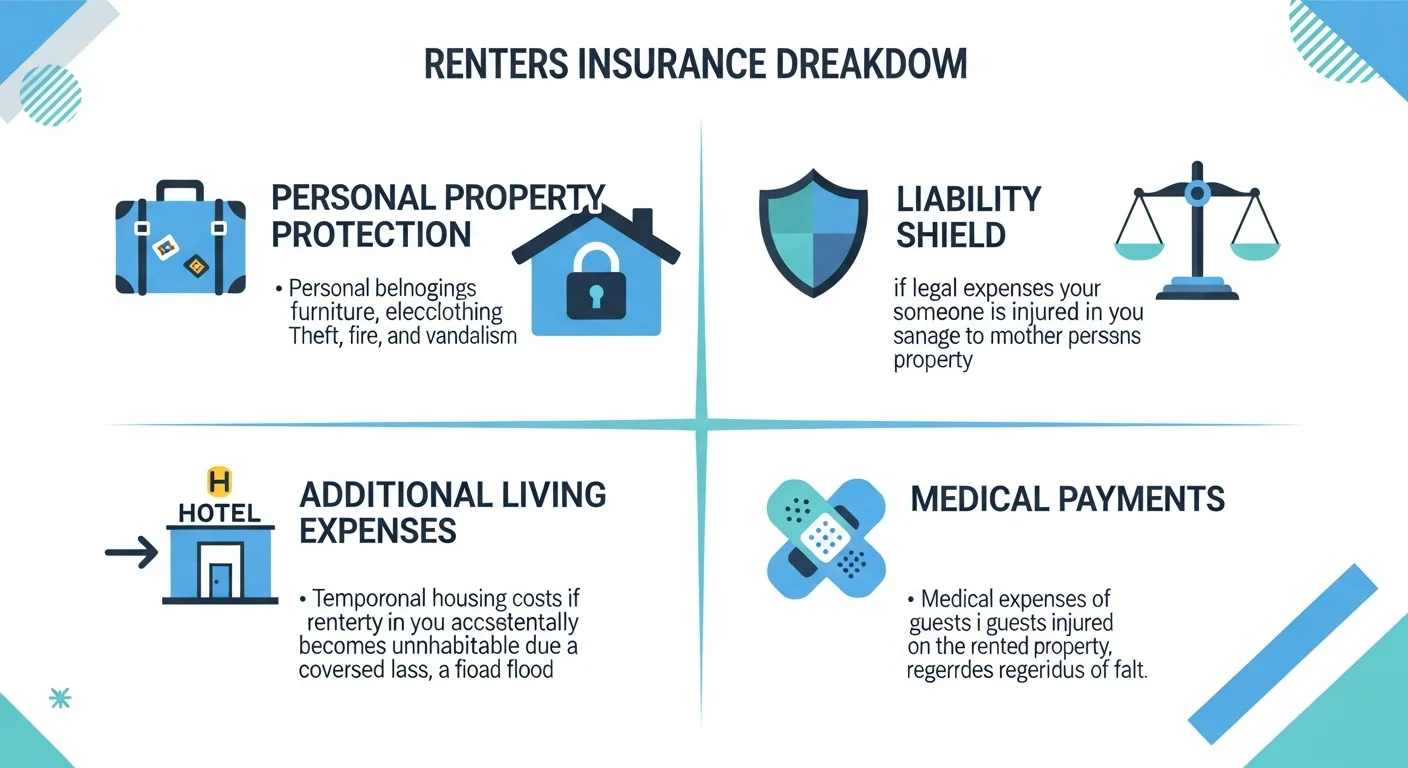
Renters insurance in Florida provides four core categories of protection through a standard HO-4 policy. Understanding each coverage type helps you determine how much protection you actually need.
Renters insurance in Florida is an HO-4 policy that protects tenants’ personal property, provides liability coverage, and pays for temporary living expenses after covered events like hurricanes, fires, and theft. Insurance Underwriters helps Florida renters customize coverage to match the specific risks in their area, from coastal wind damage to inland flooding concerns.
Coverage for Your Personal Belongings
Personal property coverage is the core of every renters insurance policy. It reimburses you for the cost of repairing or replacing your belongings if they are damaged or destroyed by a covered peril. In Florida, covered perils typically include fire, lightning, windstorm (including hurricanes), hail, theft, vandalism, smoke damage, and water damage from burst pipes or appliance leaks.
Most Florida renters carry between $20,000 and $50,000 in personal property coverage. When choosing your limit, walk through your rental and add up what it would cost to replace everything you own: furniture, electronics, kitchen appliances, clothing, jewelry, sporting equipment, and anything else of value. Many people underestimate this figure significantly.
You will need to choose between two valuation methods:
| Valuation Method | How It Works | Example: 5-Year-Old Laptop ($1,500 New) | Best For |
|---|---|---|---|
| Actual Cash Value (ACV) | Pays current depreciated value | Payout: ~$500 | Lower premiums, budget-conscious renters |
| Replacement Cost Value (RCV) | Pays full cost to buy a new equivalent item | Payout: $1,500 | Full protection, recommended for most renters |
Replacement cost coverage costs slightly more but pays significantly more at claim time. For most Florida renters, the extra $20 to $40 per year is worth the peace of mind.
Protection Beyond Your Four Walls
A renters policy extends far beyond your personal items by providing crucial liability coverage. Think of this as your financial backstop if someone is injured in your rental and you’re held legally responsible. For example, if a guest slips on a wet kitchen floor, your policy can cover their medical bills and your legal defense costs if a lawsuit follows. Without this coverage, you would face these expenses—which can easily reach tens or even hundreds of thousands of dollars—on your own. This protection is a cornerstone of any sound personal risk management plan.
Your policy also includes Additional Living Expenses (ALE), often called “loss of use” coverage. If a covered event like a fire or hurricane makes your rental uninhabitable, ALE pays for the reasonable costs you incur while displaced. This includes expenses like hotel stays, restaurant meals, and even laundry services. In Florida, where post-hurricane repairs can take weeks or months, this coverage is invaluable. It allows you to maintain your standard of living without depleting your savings, providing essential financial stability during a chaotic time. Properly structuring this coverage is key to building a resilient long-term protection plan.
Finally, most renters policies include Medical Payments to Others. This is a no-fault benefit designed to cover minor medical bills if a guest is injured in your home, regardless of who is at fault. For instance, if a friend cuts their hand while helping you cook, this coverage can pay for their visit to an urgent care clinic. It acts as a goodwill gesture that can resolve small incidents quickly and amicably. More importantly, it often prevents minor accidents from turning into significant liability claims, working hand-in-hand with your primary liability coverage to protect your financial future.
Protection When You’re at Fault (Liability)
Liability coverage protects you financially if someone is injured in your rental unit or if you accidentally damage someone else’s property. This includes legal defense costs if you are sued. Standard policies start at $100,000 in liability coverage, though many landlords and umbrella insurance advisors recommend $300,000 or more.
Common liability scenarios for Florida renters include a guest slipping on a wet floor, your dog biting a visitor, or water damage from your unit leaking into a neighbor’s apartment below you.
What if You Can’t Live in Your Rental?
If a covered event makes your rental uninhabitable, loss of use coverage pays for temporary housing, meals, and other necessary expenses above your normal cost of living. In Florida, this coverage is critical because hurricane damage can displace renters for weeks or even months. Most policies cover 20% to 30% of your personal property limit for additional living expenses.
Covering Medical Bills for Guests
This coverage pays for minor medical expenses when a guest is injured in your rental, regardless of who is at fault. Limits typically range from $1,000 to $5,000. It is designed to cover small incidents without requiring a liability claim, such as a friend who trips on a loose rug and needs an emergency room visit.
Optional Coverages to Consider
A standard HO-4 policy provides a solid foundation, but your lifestyle might require a few adjustments. Think of your base policy as a well-built home and optional coverages as the custom security features you add for specific threats. These endorsements, or add-ons, fill common gaps in coverage and are usually very affordable. For a few extra dollars a month, you can add thousands in protection against events that are surprisingly common in Florida. An experienced advisor can help you identify which endorsements make sense for your specific situation, ensuring you aren’t paying for coverage you don’t need while also preventing you from being exposed to unnecessary risk. This strategic approach turns your policy from a simple expense into a tool for financial resilience.
Water Backup Coverage
One of the most important endorsements for any Florida renter is water backup coverage. Standard renters policies cover water damage from things like a burst pipe, but they almost always exclude damage from water that backs up through sewers or drains. With Florida’s heavy rainfall and aging infrastructure, sewer and drain backups are a frequent problem. Adding water backup coverage to your policy can pay for damage to your belongings and the cost of water removal if your toilet overflows or a city sewer line backs into your ground-floor apartment. It’s a small price to pay to avoid a messy and expensive cleanup on your own dime.
Personal Injury Coverage
Personal injury coverage is another smart addition that expands your liability protection beyond simple bodily injury or property damage. This endorsement covers you against claims of libel, slander, false arrest, malicious prosecution, or wrongful eviction. While this might sound like coverage only a celebrity would need, in an era of social media reviews and online commentary, a casual post could lead to an expensive defamation lawsuit. For professionals and executives who have a public profile, this coverage provides an essential layer of financial defense against claims that could damage both your reputation and your bank account. It’s a key part of a comprehensive risk management plan.
Inflation Coverage
Over time, the cost to replace your belongings will increase due to inflation. The $30,000 in personal property coverage that seems adequate today might not be enough to replace everything you own five years from now. An inflation guard endorsement automatically increases your coverage limits each year by a certain percentage, typically between 2% and 4%. This helps your policy keep pace with the rising cost of goods without you having to manually review and update your limits every year. It’s a simple, set-it-and-forget-it feature that ensures your protection remains effective over the long term, letting you focus on other priorities.
Special Considerations for Pets and Roommates
Your living situation directly impacts your insurance needs. Adding a pet or a roommate to your household introduces new risks and complexities that your standard policy might not automatically address. Before you sign a lease with a friend or bring home a furry companion, it’s important to understand the insurance implications. A quick conversation with your insurance advisor can help you make sure your policy is structured correctly to handle these common scenarios, preventing future conflicts and coverage gaps. This proactive approach is key to maintaining both your financial security and your personal relationships, ensuring everyone and everything you care about is properly protected.
Understanding Pet Damage Coverage
Your renters insurance policy includes liability protection that extends to your pets. If your dog bites a visitor or injures another animal, your liability coverage can pay for the medical bills and any legal costs if you are sued. However, it’s crucial to know what isn’t covered. Renters insurance does not cover damage your own pet causes to your rental unit, such as chewing walls or staining carpets; your security deposit is intended for that type of damage. Also, be aware that many insurance carriers have a list of restricted dog breeds, so you may need to shop around to find a company that will cover your specific pet.
Sharing a Policy with Roommates
While splitting a renters insurance policy with a roommate might seem like an easy way to save money, it can create significant problems. When you share a policy, the coverage limits are also shared. That means a $40,000 personal property limit must cover everyone’s belongings, not $40,000 for each of you. Furthermore, a claim filed by one roommate goes on the insurance record for everyone on the policy, which can raise your future rates. Payouts are issued with all named insureds’ names on the check, creating a logistical headache. For these reasons, it is almost always better for each roommate to purchase their own separate policy. It provides cleaner coverage and prevents financial disputes down the road.
What Isn’t Covered by Renters Insurance in Florida?
Understanding the exclusions in a Florida renters insurance policy is just as important as understanding what it covers. Several major risks that Florida renters face are not included in a standard HO-4 policy.
- Flooding. Standard renters insurance does not cover flood damage. Florida is the most flood-prone state in the country, and even renters who do not live in a designated flood zone can experience flooding from heavy rainfall or storm surge. You need a separate flood insurance policy through the National Flood Insurance Program (NFIP) or a private insurer.
- Earthquake and sinkhole damage. While earthquakes are rare in Florida, sinkholes are a genuine risk in certain areas, particularly Central Florida. Standard policies exclude ground movement. You may need a separate sinkhole endorsement.
- Your landlord’s building. Your renters insurance policy covers your personal belongings and liability, not the physical structure of the building. That is your landlord’s responsibility.
- Roommate’s belongings. Unless your roommate is listed on your policy, their possessions are not covered. Each tenant should carry their own renters insurance.
- High-value items beyond policy sub-limits. Most policies cap payouts for individual categories such as jewelry ($1,500), electronics ($2,500), and fine art ($2,500). If you own items exceeding these sub-limits, you need a scheduled personal property endorsement or a separate floater policy.
- Intentional damage or neglect. Any damage you cause intentionally or through gross negligence is excluded.
- Pest damage. Damage from termites, bed bugs, rodents, or other pests is not covered.
How Much Does Renters Insurance Cost in Florida?
Renters insurance in Florida is remarkably affordable compared to other types of property insurance. The average annual premium ranges from $150 to $300 per year, depending on your location, coverage limits, and deductible. That works out to roughly $13 to $25 per month.
The average cost of renters insurance in Florida ranges from $150 to $300 per year, making it one of the most affordable types of property insurance available. Premiums vary based on location, coverage limits, deductible amount, credit score, and claims history. Miami renters typically pay more than Orlando or Tampa renters due to higher hurricane exposure and property crime rates.
Here is what Florida renters can expect to pay based on location:
| Florida City | Average Annual Cost | Average Monthly Cost | Key Cost Driver |
|---|---|---|---|
| Miami | $199 – $280 | $17 – $23 | Hurricane risk, high property crime |
| Fort Lauderdale | $163 – $240 | $14 – $20 | Coastal wind exposure |
| Tampa | $150 – $220 | $13 – $18 | Moderate hurricane risk |
| Orlando | $140 – $200 | $12 – $17 | Inland location, lower wind risk |
| Jacksonville | $145 – $210 | $12 – $18 | Moderate coastal risk |
| Tallahassee | $130 – $190 | $11 – $16 | Lower overall risk profile |
Several factors directly influence your renters insurance premium in Florida:
- Location. Coastal areas with higher hurricane and flood exposure pay more. Miami-Dade, Broward, and Palm Beach counties have the highest premiums statewide.
- Coverage limits. Higher personal property and liability limits increase your premium proportionally.
- Deductible amount. Choosing a higher deductible ($1,000 vs. $500) lowers your premium but increases your out-of-pocket expense at claim time.
- Credit score. Florida insurers use credit-based insurance scores to set rates. Renters with good credit pay significantly less.
- Claims history. Previous insurance claims can increase your premium for three to five years.
- Pet ownership. Certain dog breeds classified as high-risk can increase liability premiums or result in coverage exclusions.
A Look at Average Costs: Florida vs. National
When you look at the high cost of other insurance in the Sunshine State, you’ll be pleasantly surprised by renters insurance. In Florida, the average annual premium is quite affordable, typically ranging from $150 to $300. This breaks down to about $13 to $25 per month—less than what many of us spend on coffee or streaming services. While the national average for renters insurance hovers around $15 per month, Florida’s rates are very competitive, especially considering the higher risk of weather-related events. For a relatively small monthly cost, you get a significant amount of protection for your personal belongings and financial well-being.
Comparing Rates from Major Florida Insurers
While major insurers offer policies across the state, the premium you’re quoted will depend heavily on your specific location. Rates can vary significantly from one city to the next, primarily due to differences in local risks like hurricane exposure and property crime rates. For instance, renters in Miami can expect to pay between $199 and $280 annually, while those in a lower-risk area like Tallahassee might pay as little as $130 to $190. Renters in other major cities fall somewhere in between, with average annual costs of $150 to $220 in Tampa and $140 to $200 in Orlando. An independent broker can help you compare quotes from different carriers to find the best rate for your zip code.
How Florida Stacks Up Against Other States
Given its location, you might expect Florida to have some of the highest renters insurance rates in the country, but that isn’t the case. While the state’s average is slightly above the national median, it remains one of the most affordable types of property insurance you can buy. When compared to other hurricane-prone states along the Gulf Coast, such as Louisiana and Mississippi where rates can be much higher, Florida renters insurance offers incredible value. This affordability makes it an easy and smart decision for every tenant in the state to secure coverage and protect their assets from the unexpected.
Key Factors That Determine Your Premium
The average rates provide a good baseline, but your actual renters insurance premium is a personalized figure. Insurers calculate your price by evaluating a specific set of factors related to your location, your coverage choices, and your personal background. Understanding these elements can help you see what’s driving your cost and identify ways you might be able to save money. The most significant factors include where you live, the amount of coverage you select, the deductible you choose, your credit history, and any past insurance claims. Even your pets can play a role in the final price you pay for your policy.
Your Rental Property’s Location and Condition
It’s no surprise that in insurance, location is everything. In Florida, coastal areas with higher exposure to hurricanes and flooding, like Miami-Dade and Broward counties, consistently have the highest premiums. If you live in a neighborhood with a higher crime rate, that can also increase your cost. Beyond your zip code, insurers look at the specifics of your rental building. For example, a newer building made of concrete block will likely earn you a better rate than an older, wood-frame structure. The presence of safety and security features, such as smoke detectors, fire alarms, and a central security system, can also lead to discounts on your premium.
Your Coverage Selections
The amount of protection you choose has a direct impact on your premium. The higher you set your personal property and liability limits, the more your policy will cost. While it might be tempting to choose the lowest limits to save money, it’s crucial to have enough coverage to fully replace your belongings and protect your assets. Another key choice is your deductible—the amount you pay out-of-pocket on a claim. Opting for a higher deductible, like $1,000 instead of $500, will lower your annual premium. Just be sure you’re comfortable paying that amount if you need to file a claim.
Your Personal Profile and Insurance History
Insurers also look at factors unique to you to determine your rate. In Florida, carriers use a credit-based insurance score, which means a strong credit history can result in a significantly lower premium. Your claims history also matters; if you’ve filed renters insurance claims in the past three to five years, you may face a higher rate. Finally, pet ownership can influence your liability premium. If you own a dog breed that an insurer classifies as high-risk, your rate may increase, or you could even have coverage for dog bites excluded from your policy. This is a key reason to discuss your full situation with an advisor to avoid any coverage gaps.
Is Renters Insurance in Florida a Necessity?
Florida law does not require tenants to carry renters insurance. However, your landlord or property management company almost certainly does. The vast majority of Florida landlords include a renters insurance requirement in their lease agreements, typically mandating at least $100,000 in liability coverage.
Even if your landlord does not require it, renters insurance is one of the smartest financial decisions a Florida tenant can make. Consider this: if a hurricane forces you out of your apartment and destroys your furniture, electronics, and clothing, you would be responsible for replacing everything out of pocket without insurance. That could easily exceed $15,000 to $30,000 for an average household.
Compare that to paying $15 to $25 per month for a comprehensive policy. The math is overwhelmingly in favor of coverage.
Talk to Insurance Underwriters about customizing a renters insurance policy that fits your budget and protects everything you own.
Why “Apartment Insurance” is a Smart Investment
Even if your lease doesn’t demand it, securing renters insurance is one of the most strategic financial moves you can make as a Florida tenant. The state’s unique exposure to hurricanes, tropical storms, and high property crime rates means the risk of losing everything is very real. Consider the alternative: if a storm makes your apartment unlivable and destroys your belongings, you could face replacing $15,000 to $30,000 worth of furniture, electronics, and clothing out of your own pocket. Compared to an average annual premium of $150 to $300, the math is overwhelmingly in favor of coverage. For a small monthly cost, you gain comprehensive protection for your property, liability, and temporary living expenses, ensuring a single disaster doesn’t become a long-term financial crisis.
Renters vs. Condo Insurance in Florida: Key Differences
Florida tenants sometimes confuse renters insurance with condo insurance (HO-6 policies). While both cover personal property and liability, there are important differences.
| Feature | Renters Insurance (HO-4) | Condo Insurance (HO-6) |
|---|---|---|
| Structure coverage | None (landlord’s responsibility) | Interior walls, floors, fixtures |
| Personal property | Yes | Yes |
| Liability | Yes | Yes |
| Loss assessment | Not typically included | Covers HOA special assessments |
| Average annual cost | $150 – $300 | $500 – $1,500 |
| Who needs it | Tenants renting any property | Condo unit owners |
If you rent a condo unit, you need renters insurance, not condo insurance. The condo association’s master policy and the unit owner’s HO-6 policy do not cover your personal belongings as a tenant.
Key Risks Every Florida Renter Faces
Renting in Florida comes with risks that renters in most other states never face. Understanding these threats helps you build the right coverage strategy.
Understanding Hurricane & Windstorm Coverage
Florida averages a direct hurricane hit every three years, and tropical storms are even more frequent. Standard renters insurance covers wind damage to your personal property, but many policies include a separate hurricane or windstorm deductible that is higher than the standard deductible. This is typically 2% to 5% of your personal property coverage limit.
For example, if you have $30,000 in personal property coverage and a 2% hurricane deductible, you would pay the first $600 out of pocket before insurance kicks in. Review your policy carefully to understand your hurricane deductible.
Florida’s Flood Risk: Are You Covered?
Florida accounts for more flood insurance claims than any other state. As a renter, you can purchase flood insurance through the NFIP or a private insurer. Flood policies for renters typically cost $100 to $300 per year and cover personal property up to $100,000. If you live in a ground-floor apartment or a flood-prone area, this coverage is essential.
Theft and Property Crime: How Insurance Helps
Florida’s property crime rate is higher than the national average, particularly in urban areas like Miami, Orlando, and Jacksonville. Renters insurance covers theft of your belongings both inside and outside your home. If your laptop is stolen from your car or your bicycle is taken from a locked storage unit, your renters policy covers the loss (minus your deductible).
When is Water Damage Covered (and When Isn’t It)?
Florida’s high humidity and aging building infrastructure make water damage one of the most common renters insurance claims in the state. Burst pipes, leaking water heaters, and air conditioner condensation overflow are all covered by a standard renters policy. However, gradual water damage from neglected maintenance is not covered.
How to Figure Out How Much Coverage You Need
Calculating the right amount of renters insurance requires a systematic inventory of your belongings. Follow these steps:
- Room-by-room inventory. Walk through every room and list everything you own. Include furniture, electronics, appliances, clothing, books, kitchenware, and decorations.
- Estimate replacement costs. For each item, note what it would cost to buy a brand-new replacement today, not what you originally paid.
- Total your assets. Add up all replacement costs. This is your target personal property coverage limit.
- Document everything. Take photos or video of your belongings. Store this documentation in the cloud or somewhere outside your rental unit so it survives a disaster.
- Review annually. Update your inventory after major purchases or lifestyle changes.
Most Florida renters find their belongings are worth between $20,000 and $50,000. If you own high-value items like expensive jewelry, electronics, or musical instruments, your total may be higher.
What Information Do You Need to Get a Quote?
Getting a renters insurance quote is a lot simpler than you might think. The key is having the right information ready to go. When you’re prepared, the process is fast and ensures you get the most accurate pricing for the coverage you need. Let’s walk through exactly what you’ll need to have on hand to get a quote and secure your protection.
- Your Personal Details: This is the easy part. You’ll need your full name, date of birth, and an email address for the insurer to start building your profile.
- The Rental Address: Provide the full address of the property you’re renting. Location is a major factor in determining your rate, as it helps insurers understand local risks like storm frequency or property crime rates.
- Value of Your Belongings: Using the home inventory you created, you’ll need a solid estimate of what it would cost to replace everything you own. This is crucial for setting your personal property coverage limit.
- Your Deductible Choice: You’ll need to decide how much you’re willing to pay out-of-pocket for a claim. Choosing a higher deductible, like $1,000 instead of $500, will lower your monthly premium.
- A Few Other Factors: Be ready to answer questions about your insurance claims history and whether you have any pets. Insurers also often use a credit-based insurance score, so having good credit can help you get a better rate.
Filing a Florida Renters Insurance Claim: A Step-by-Step Guide
When disaster strikes, knowing how to file a claim quickly and correctly can mean the difference between a smooth payout and a prolonged battle. Here is the process:
- Document the damage immediately. Take photos and videos of all damaged or stolen items before cleaning up or making repairs. This evidence is critical for your claim.
- File a police report. If your claim involves theft, vandalism, or a break-in, file a police report within 24 hours. Your insurer will require a copy.
- Contact your insurer. Report the claim as soon as possible. Most Florida insurers have 24/7 claims hotlines and mobile apps for filing.
- Provide your inventory. Submit your personal property inventory, photos, and receipts. The more documentation you have, the faster and more complete your payout will be.
- Get repair estimates. If items can be repaired rather than replaced, obtain written estimates from qualified service providers.
- Track all expenses. If you are displaced, keep receipts for temporary housing, meals, and other additional living expenses.
Florida law requires insurers to acknowledge your claim within 14 days and make a decision within 90 days. If you believe your claim was unfairly denied, you can file a complaint with the Florida Department of Financial Services.
Smart Ways to Save on Your Florida Renters Insurance
While renters insurance is already affordable, there are several ways to reduce your premium further:
- Bundle with auto insurance. Most insurers offer a 5% to 15% discount when you bundle renters and auto policies.
- Increase your deductible. Raising your deductible from $500 to $1,000 can reduce your premium by 15% to 25%.
- Install safety devices. Deadbolt locks, smoke detectors, fire extinguishers, and security systems can qualify you for discounts.
- Maintain good credit. Florida insurers use credit scores to set rates. A strong credit score can save you hundreds over time.
- Choose a claims-free record. Avoid filing small claims that you can cover out of pocket. A clean claims history keeps your premium low.
- Ask about discounts. Many insurers offer discounts for paperless billing, paying annually instead of monthly, being a non-smoker, or having a protective device.
- Compare quotes. Rates vary significantly between insurers. Get quotes from multiple providers to find the best rate for your coverage needs.
Contact Insurance Underwriters for a free renters insurance comparison and find out how much you could save on comprehensive coverage for your Florida rental.
Ask About These Common Discounts
Insurers want to reward responsible tenants who take steps to minimize risk. Many companies offer a variety of discounts that can lower your premium, but they aren’t always advertised upfront. It’s always a good idea to ask your agent what discounts you might qualify for. You might be surprised by how many simple actions, from installing a security camera to going paperless, can translate into real savings on your policy. These small discounts can add up, making your already affordable coverage even more budget-friendly.
Discounts for a Secure Home
Insurance companies see a secure home as a less risky home, and they’re willing to reward you for it. You can often earn a discount by having safety and security devices installed in your rental. This includes basics like deadbolt locks on exterior doors, smoke detectors, and fire extinguishers. If your rental is equipped with a central alarm system that monitors for fire and theft, the discount can be even more significant. Even if your landlord doesn’t provide these, investing in a small fire extinguisher or a simple battery-powered security camera could pay for itself through lower insurance premiums over time.
Discounts for How You Pay and Plan
Your administrative choices and personal habits can also lead to savings. Many insurers offer a small discount for enrolling in paperless billing, which saves them printing and mailing costs. You can also find savings by choosing to pay your entire annual premium upfront instead of in monthly installments. This reduces the insurer’s billing overhead and eliminates the risk of missed payments. Additionally, some companies offer a non-smoker discount, as smoking is a leading cause of residential fires. These discounts are easy to qualify for and can chip away at your total cost without requiring any changes to your property.
The Power of Bundling: Combining Policies for Maximum Savings
One of the most impactful ways to save on renters insurance is by bundling it with another policy from the same provider, most commonly your auto insurance. Insurers love multi-policy customers and typically offer a significant discount, often between 5% and 15%, on both policies. This strategy not only saves you money but also simplifies your life by consolidating your insurance with one company. When you have a single point of contact for your renters and auto coverage, managing payments and making policy changes becomes much more convenient. It’s a straightforward way to get more value from your insurance relationship.
While bundling is a fantastic savings strategy, it’s crucial to remember that not all bundles are created equal. The company with the cheapest auto insurance might not have the most competitive renters policy, and vice-versa. The key is to compare bundled quotes from several different providers to find the true sweet spot of price and protection. Working with an independent brokerage like Insurance Underwriters allows you to compare bundled options from multiple top-rated carriers at once. This ensures you’re not just getting a discount, but the best possible deal for your specific needs.
Frequently Asked Questions About Renters Insurance in Florida
Is renters insurance required by law in Florida?
No. Florida does not legally require tenants to carry renters insurance. However, most landlords and property management companies in Florida require it as a condition of the lease, typically with at least $100,000 in liability coverage. Even without a legal mandate, renters insurance protects your finances against theft, fire, hurricanes, and liability claims.
Does renters insurance cover hurricane damage in Florida?
Yes, standard renters insurance covers wind damage to your personal property from hurricanes. However, it does not cover flood damage, which requires a separate flood insurance policy. Most Florida renters policies also include a separate hurricane deductible, typically 2% to 5% of your personal property limit, which is higher than the standard all-peril deductible.
How much renters insurance do I need in Florida?
Most Florida renters need between $20,000 and $50,000 in personal property coverage, at least $100,000 in liability coverage (though $300,000 is recommended), and a loss of use limit equal to 20% to 30% of their property coverage. Conduct a home inventory to determine the exact replacement cost of all your belongings.
Does renters insurance cover flooding in Florida?
Renters insurance covers your belongings against fire, theft, wind, and many other perils, but not flooding. If you live in a flood zone in Florida, you need a separate flood insurance policy. Even renters outside designated flood zones should consider flood coverage, since 25% of flood claims come from low-to-moderate-risk areas.
Can my landlord require me to have renters insurance in Florida?
Yes. Florida landlords can legally require renters insurance as a condition of the lease. For a detailed look at what landlord insurance protects from the property owner’s perspective, see our complete guide. This is a standard practice, and most Florida lease agreements include specific coverage minimums. If your landlord requires it, you must provide proof of insurance, typically a declarations page or certificate of insurance naming the landlord as an interested party.
Actual Cash Value vs. Replacement Cost: Which Is Right for You?
Actual cash value (ACV) pays the current depreciated value of your damaged or stolen item. Replacement cost value (RCV) pays the full cost to buy a new equivalent item at today’s prices. RCV policies cost slightly more but provide significantly better payouts at claim time. For most Florida renters, replacement cost coverage is worth the additional premium.
Key Takeaways
- Your Landlord’s Policy Doesn’t Cover You: Remember that your landlord’s insurance only protects the physical building, not your personal property. Renters insurance provides a crucial financial safety net for your belongings, covering everything from furniture to electronics in case of theft, fire, or a hurricane.
- Standard Policies Have Key Exclusions: Be aware that a basic renters policy will not cover flood damage, which requires a separate policy and is a major risk in Florida. It is also important to review your coverage for specific hurricane deductibles and sub-limits on high-value items like jewelry or art.
- Optimize Your Coverage for Better Value: Choose replacement cost value (RCV) to get the full amount needed to buy new items after a claim. You can significantly lower your premium by bundling with auto insurance, increasing your deductible, and asking for discounts related to home safety devices.
Comments
Comments are closed.